A decision-making aid for your contract management
Medium-sized companies in particular are facing a crucial decision when it comes to digitising their contract management: cloud, on-premises or hybrid? This architectural decision not only affects investment costs and IT expenditure, but also integration capability and security. While cloud-based CLM systems offer scalability, predictable operating costs and fast updates, on-premises solutions score points for full data sovereignty, customisability and internal compliance control.
Choosing the right architecture for digital contract management is therefore much more than just an IT decision; it determines how flexibly your company can respond to new legal requirements, system integrations and AI-supported functions. The aim of this article is to systematically compare different CLM software models and highlight what SMEs should look for when selecting the right contract management system.
Whether you are currently modernising an existing system or investing in professional CLM for the first time, this CLM software comparison provides you with the basis for deciding on a solution that is both future-proof and compliant.
Focus on architecture issues: cloud vs. on-premises vs. hybrid
Choosing the right CLM architecture is one of the key decisions when implementing a contract management system. This is especially true for medium-sized companies, which have to weigh up efficiency, data sovereignty and investment security. Each deployment model (cloud, on-premises or hybrid) has specific advantages and disadvantages that have a lasting impact on subsequent operation and scalability.
Cloud: Scalability and innovation from the cloud
More and more companies are turning to cloud-based CLM solutions because they enable a quick start with comparatively low IT costs.
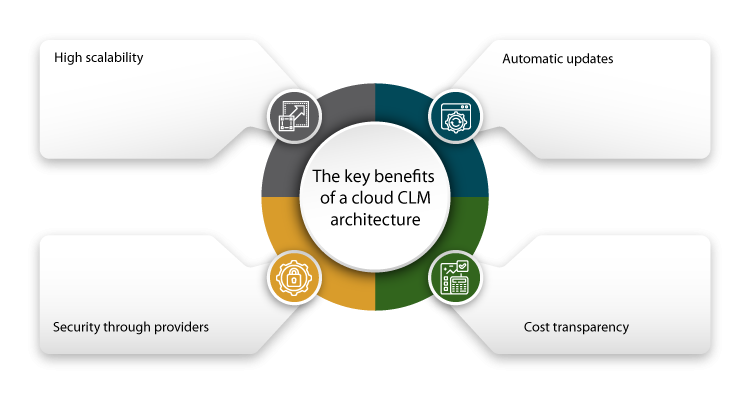
The most important advantages of a cloud CLM architecture:
-
High scalability: New users, locations or clients can be added flexibly without additional hardware.
-
Automatic updates: The provider ensures continuous development, bug fixes and security updates.
-
Security through provider: Reputable cloud providers meet high security standards (e.g. ISO 27001) and operate their data centres in the EU.
-
Cost transparency: Instead of high initial investments, companies pay usage-based fees (subscription model).
One disadvantage can be limited control over data flows, especially for companies with sensitive contract or personal data. It is therefore worth looking at providers that offer sovereign cloud or EU-only hosting concepts in order to better meet compliance requirements.
On-premises: Maximum control and integration strength
For companies with particularly high security requirements or complex IT structures, on-premises software remains an attractive option.
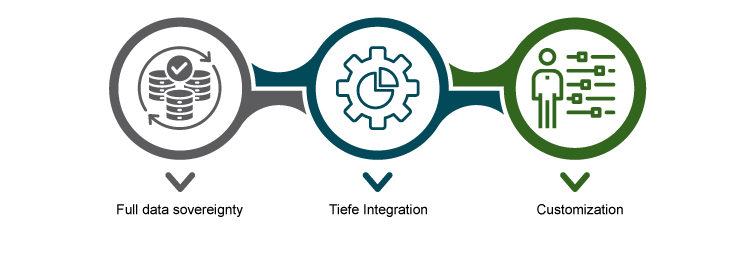
Installation in your own infrastructure offers several advantages:
-
Full data sovereignty: All contract data remains in your own data centre. This is a plus point for industries with high data protection requirements.
-
Deep integration: Connection to existing systems (e.g. ERP, DMS, CRM) can be implemented individually.
-
Customisation: Workflows, approval processes and data models can be tailored precisely to company-specific processes.
However, this comes with higher initial costs for hardware, implementation and maintenance, as well as ongoing expenses for updates and security patches. An on-premises model is therefore particularly suitable for companies with their own IT department and clear governance structures.
Hybrid & managed hosting: the flexible middle ground
A third option is increasingly establishing itself between cloud and on-premises. These are known as hybrid models or managed hosting solutions.
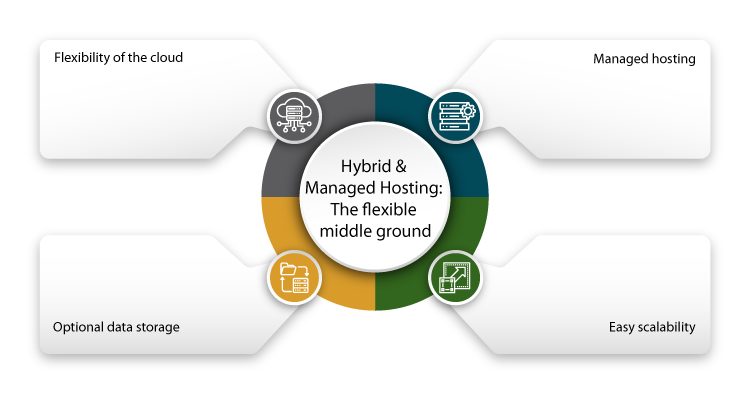
They combine the advantages of both worlds:
-
Flexibility of the cloud with simultaneous data control through on-premises components such as server hardware, storage systems, identity and access management, and security infrastructure.
-
Managed hosting relieves internal IT resources, as maintenance, monitoring, and patches are handled by the provider.
-
Optional data storage in EU data centres ensures GDPR compliance and legal certainty.
-
Easy scalability through modular use, such as for new locations, subsidiaries or service providers.
For medium-sized companies in particular, this approach can represent the best long-term balance between security, cost control and modernisation. Hybrid CLM systems also offer the option of gradually migrating from existing on-premises solutions to the cloud, for example through hybrid synchronisation models for documents, contracts and user rights.
💡 SoftGuide practical tip:
Ask potential providers specifically about cloud migration tools and configurable hybrid scenarios. These are particularly helpful if your company plans to pursue an expanded cloud strategy in the future but must continue to meet compliance requirements in the short term.
Integrations and interfaces
A powerful contract lifecycle management (CLM) system only delivers its full benefits when it integrates seamlessly into the company's existing IT landscape. For medium-sized businesses, it is crucial that the contract management software does not operate in isolation, but intelligently links data flows from ERP, CRM and document management systems.
The API and integration capabilities of CLM software are therefore one of the biggest productivity levers in contract management, determining efficiency, data quality and automation potential.
Why are interfaces crucial in digital contract management?
Many companies struggle with data silos: contract information is scattered across different applications, resulting in redundant entries, search effort and sources of error. Modern contract management solutions break down these silos and ensure that contract data can be used across systems.
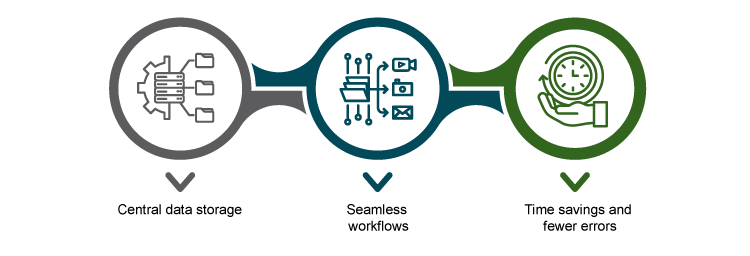
An open interface concept offers:
-
Centralised data storage: Contract data, deadlines and status information are kept synchronised across all relevant systems.
-
Seamless workflows: Changes to contracts or approvals are processed digitally without switching between systems.
-
Time savings and fewer errors: Automatic synchronisation reduces manual entries and enables accurate data in real time.
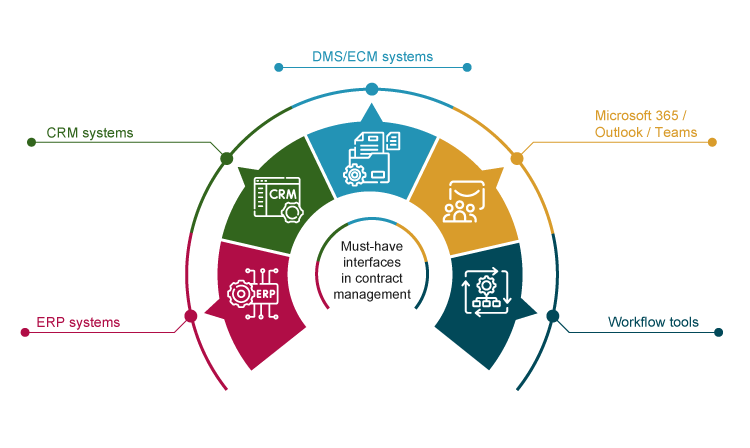
Must-have interfaces in contract management
When introducing CLM software, the following integrations should be considered as standard in order to make processes truly consistent:
-
ERP systems: Synchronisation of contract values, supplier IDs and payment terms.
-
CRM systems: Linking customer contracts with contact persons and sales opportunities.
-
DMS/ECM systems: Audit-proof storage of all contract documents, automatic versioning.
-
Microsoft 365 / Outlook / Teams: Creation, approval and management of contracts directly from familiar applications.
-
Workflow tools: Support for individual approval processes, reminders of deadlines or transfer to accounting systems.
Many modern systems pursue an API-first strategy, which means that all CLM functions can also be accessed via interfaces. This makes it possible to build your own business apps or BI reports on top of it, for example to analyse contract risks, supplier performance or deadline deviations.
CLM meets AI: Intelligent contract analysis in practice
While classic contract management systems primarily support the central storage and control of documents, artificial intelligence (AI) opens up completely new possibilities in modern contract lifecycle management (CLM). Where manual checks, Excel lists and control runs were once necessary, machine learning models and natural language processing (NLP) algorithms now take over time-consuming routine tasks reliably and scalably.
For small and medium-sized businesses in particular, this means less legal work, faster turnaround times and greater transparency regarding contract risks.
From text recognition to true contract intelligence
Modern CLM systems rely on AI-based modules that go far beyond simple text recognition (OCR). They are able to recognise, categorise and automatically evaluate legal content. This allows companies to efficiently analyse even large volumes of contracts and identify legal risks at an early stage.
Key application scenarios are:
-
Clause recognition and evaluation: AI automatically identifies standard clauses, deviations or missing passages and suggests wording from the clause library.
-
Automatic metadata capture: Contract content such as terms, amounts, deadlines and partner data is read during upload and stored in a structured manner.
-
Risk assessment and scoring: Algorithms analyse deviations from contract guidelines or compliance requirements and generate a risk profile.
-
Predictive alerts: AI-based systems recognise upcoming contract expiries or unfavourable clause combinations and proactively inform the responsible teams.
Another growing trend is the use of generative AI in CLM: language models help to automatically create draft contracts, comment on deviations and generate summaries for management reports.
Advantages for legal departments and purchasing
The integration of AI tools not only reduces the workload for lawyers, but also for specialist departments such as purchasing or controlling:
-
Accelerated contract review: Routine tasks, such as identifying payment terms or liability limits, are automated.
-
Standardised risk assessment: AI assessments ensure that all contracts undergo a uniform compliance check, regardless of who is processing them.
-
Data-driven decisions: AI-supported analyses provide key metrics for contract performance, supplier evaluation and renegotiation potential.
-
Audit security: Every automatic evaluation is documented and logged in a traceable manner. This is an advantage for ISO or compliance audits.
AI can help companies that are digitising contract portfolios that have grown over many years to tap into unstructured data sets. This turns pure contract management into genuine contract intelligence, a measurable competitive advantage.
Maturity of AI in CLM: evolution instead of revolution
Not all AI functions on the market are equally mature. Many providers distinguish between rule-based systems (‘if-then logic’) and genuine machine learning models that learn through training.
When comparing software, you should therefore pay attention to the following criteria:
- Are there preconfigured AI models for contract content (e.g. NDAs, supplier contracts, licence agreements)?
- Does the AI support multilingual documents?
- Can your own clause models be trained or adapted?
- Is the AI locally explainable – i.e. is it possible to understand how decisions are made (‘explainable AI’)?
Security and compliance as decision-making criteria
In contract management, security is much more than a technical obligation; it is the basis for trust, legal compliance and sustainable business processes. A modern contract lifecycle management system must therefore not only protect confidential contract content, but also reliably meet regulatory requirements such as the GDPR and industry-specific compliance requirements.
GDPR and data sovereignty: The foundation of digital contract management
Since the General Data Protection Regulation (GDPR) came into force, companies must be able to prove where personal data is stored, for what purpose and who has access to it.
A CLM system supports the fulfilment of these requirements through:
-
Transparent data flows: All activities in contract management (entry, modification, access) are logged in an audit-proof manner.
-
Rights and role concepts: Access to contract data is based on the need-to-know principle.
-
Contract deletion and anonymisation functions: Data can be automatically deleted after the expiry of statutory retention periods.
-
Hosting within the EU: Many providers ensure GDPR compliance through data centres in Germany or the EU, ideal for companies with high compliance requirements.
💡 SoftGuide practical tip
Check whether your provider offers a Data Processing Agreement (DPA) that regulates the handling of personal data in accordance with EU standard contracts.
ISO certifications and safety standards: proof of quality for suppliers
Certified information security management systems (ISMS) are a strong indicator of the security of CLM software. The following standards and certificates are considered particularly trustworthy:
- ISO 27001: Internationally recognised standard for information security management and risk assessment.
- SOC 2 Type II: Proof of security, availability and data protection controls by cloud providers.
- TISAX (for the automotive industry): Relevant standard if you work with OEMs or tier suppliers.
Such certifications signal that processes, network security and data access are regularly audited. This represents a clear advantage over providers without certified security architecture.
Access control & encryption: Protection at all levels
A secure CLM solution is characterised not only by external certificates, but also by technical protective measures in day-to-day operations:
- End-to-end encryption: Contracts are encrypted during transfer and storage (e.g. AES-256).
- Multi-factor authentication (MFA): Secures user access against unauthorised logins.
- Multi-tenancy: Guarantees that customer data is strictly isolated from each other, which is particularly relevant for cloud operations.
- Audit trails: Every change, approval and signature is documented in a traceable manner, which is important for compliance and forensic analysis.
In addition, some providers offer zero-trust architectures in which all accesses are checked and authenticated by default. This effectively prevents unauthorised access to sensitive contract data.
Compliance as a strategic factor
Security is not a one-off project, but an ongoing strategic task. CLM systems that undergo regular audits, update cycles and penetration tests offer greater reliability in the long term. Particularly in view of new legislation, such as the EU Data Act Regulation or NIS2 Directive, it is worth relying on providers with a clear roadmap and certified partners.
Another plus: standardised compliance functions also allow internal and external audits to be carried out more quickly and transparently, saving time and resources.
Conclusion & checklist: Decision in a nutshell
Choosing CLM software is a strategic decision that determines the future viability, security and efficiency of contract management. A structured comparison of the options (cloud/on-premise, integrations, AI maturity, compliance) is essential, especially for small and medium-sized businesses. The ideal CLM provider should combine technological innovation, legal certainty and industry expertise, and the solution must fit seamlessly into the existing system landscape and be adaptable to future requirements.
Your checklist for selecting CLM software
The following overview will help you to systematically evaluate and prioritise the most important decision criteria:
|
Criterion |
Questions about the assessment |
Objective/benefit |
|
System architecture |
Cloud, on-premises or hybrid? Is the hosting location EU/US-compliant? |
Appropriate infrastructure choice for security and scalability |
|
Interfaces & Integration |
Can ERP, CRM and DMS systems be connected? Is there an API-first strategy? |
Avoiding data silos, consistent workflows |
|
AI functionalities |
Does the software offer automatic clause analysis, metadata recognition and risk scoring? |
Increased efficiency through intelligent automation |
|
Safety standards & certificates |
Is the provider ISO 27001 or SOC 2 certified? Are GDPR and NIS2 requirements met? |
Verifiable compliance and data protection conformity |
|
User-friendliness & acceptance |
How intuitive is the interface for specialist departments (e.g. purchasing, legal, sales)? |
Promoting user acceptance and productivity |
|
Scalability & Roadmap |
Can the solution keep pace with your growth? Is there an innovation and update strategy? |
Future security and predictability |
|
Support & Service |
Is there support in your mother language, training or SLA agreements? |
Ensuring operation and user support |
This checklist allows you to compare providers objectively and make an informed preliminary selection. A simple method: rate each criterion on a scale from 1 (not met) to 5 (very well met) and weight the factors according to your individual needs, such as security for sensitive industries or API capability for digitally networked companies.
💡 SoftGuide practical tip: Take a strategic approach to CLM comparison
-
Utilise the pilot phase: Test at least two systems with real contract data.
-
Involve users: Involve specialist departments at an early stage to avoid acceptance problems later on.
-
Think ahead: Check whether the provider is already planning AI roadmaps, hybrid models or new compliance features.
This means you are not only making a decision that is feasible in the short term, but also one that is sustainable in the long term for your contract management system.