Increasing digitalization means that not only people and organizations are involved in business relationships, but also things such as machines, devices, vehicles, or sensors. The Internet of Things (IoT) makes these objects “smart” and enables their data to be captured and used in real time. At the same time, companies are increasingly gaining insights from this data in order to make processes more efficient, plan maintenance proactively, or implement new business models.
Traditional CRM or ERP systems are often not designed for these requirements. This is exactly where a modern xRM system comes in. It extends the traditional concept of relationships to include all relevant actors, including connected objects, and thus becomes the digital link in a connected business world.
Fundamentals: What connects xRM and IoT?
xRM – A platform for all relationships
xRM (Anything Relationship Management) stands for an extended approach to relationship management: while traditional CRM systems primarily focus on interactions with customers, an xRM system goes one step further. It enables the centralized and systematic management of all relevant relationship partners. These include natural persons, organizations, or physical objects such as machines, vehicles, or buildings.
At the core is a model-driven, configurable, and highly flexible platform approach. This enables companies to define individual relationship types, assign roles, control business processes, and capture relevant information in a structured way.
By extending data models and entities, xRM is ideally suited to manage things as active participants in business relationships and this is precisely where the interface to the Internet of Things emerges.
IoT – Data source and action driver
The Internet of Things (IoT) describes the networking of physical objects equipped with sensors, actuators, and communication modules. These “smart” devices continuously generate data, for example on condition, position, usage, or environmental influences, which is sent via the internet to central systems.
The goal of IoT is to optimize processes through automated information flows, detect events in real time, and make well-founded decisions based on this data. However, this only works efficiently if the information can be processed and reused in an appropriate context.
The interplay of xRM and IoT
The integration of IoT data into an xRM system opens up new dimensions in relationship management. Machines or devices can be modeled in xRM as their own relationship partners, complete with individual properties, relationships to other entities (e.g. customers, technicians, manufacturers), and integrated processes.
Practical application examples
1. Predictive maintenance & maintenance management
Modern machines are equipped with sensors that record conditions such as temperature, pressure, or operating time. This information flows into the xRM system in real time. As soon as a defined threshold is reached, a service ticket can be created automatically or a maintenance operation can be scheduled even before a failure occurs. This reduces unplanned downtime and significantly lowers maintenance costs.
2. Lifecycle management of assets
An xRM system enables the digital management of an object’s complete lifecycle: from commissioning through maintenance and repairs to decommissioning. IoT data supplements these object records with current usage information and operating conditions. This combination of comprehensive data provides a significantly improved basis for decision-making regarding investments or service deployments.
3. Smart service & remote monitoring
In medical technology, building management, or mechanical engineering, IoT and xRM can be used to detect faults automatically and trigger service measures. The responsible technician receives all relevant information centrally via the xRM system including device data, maintenance history, and contact persons. This saves time, increases service quality, and minimizes response times.
️Example A: Connected CNC machine in the service process
Situation:
A CNC machine is assigned to a fixed location and is covered by a maintenance contract with an external service provider.
Process via xRM + IoT:
-
The machine is equipped with sensors and automatically transmits an alert to the external service provider’s xRM system in the event of a fault.
-
The xRM detects the fault status and generates a service ticket.
-
The responsible support team is informed directly including location, device data, and error description.
-
The service deployment is planned, documented, and evaluated via the xRM.
Benefits:
-
Faster response times
-
Less downtime
-
Transparent service history
Example B: Intelligent maintenance planning in medical technology
Situation:
A medical device is used regularly and continuously transmits usage data to the central xRM system.
Process via xRM + IoT:
-
Usage data is captured in real time in xRM and linked to the device’s digital object profile.
-
Based on operating hours and usage patterns, service intervals are calculated automatically.
-
The system generates calibration reminders and coordinates the necessary measures with the responsible technician team.
-
All actions are stored in the device documentation in an audit-proof manner.
Benefits:
-
Proactive maintenance
-
Compliance with regulatory requirements
-
Higher patient safety and device availability
Requirements for IoT integration in xRM
Flexible data models
The xRM platform must allow new relationship types such as “device,” “sensor,” or “system” to be defined dynamically including individual attribute sets and relationships to other entities.
Real-time processing
Events triggered by IoT devices (e.g. temperature > threshold) must be processed in real time and be transferable into workflows.
Standardized interfaces
APIs are essential for seamless connection to IoT platforms. Typical protocols include REST, MQTT, OPC UA, or AMQP.
Scalable platform architecture
Very large volumes of data can accumulate, especially in IoT environments. A high-performance, cloud-capable backend is therefore a prerequisite.
Data protection & security
Object data can also allow conclusions to be drawn about people or trade secrets. Therefore, GDPR-compliant storage, encryption, and access control are also essential in the xRM context.
Benefits and added value for companies
The combination of xRM and IoT opens up a decisive competitive advantage for companies: by linking these technologies, they are able to systematically manage not only human but also machine actors as part of their relationship network. This creates new opportunities for automation, optimization, and strategic management.
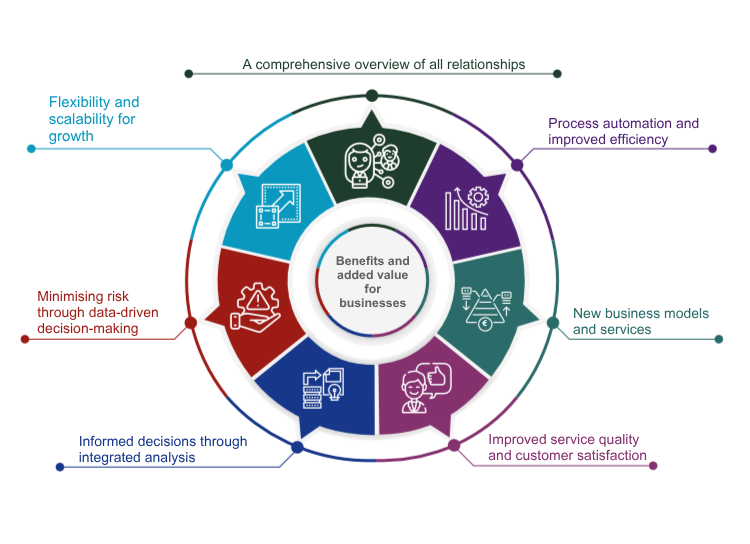
Holistic overview of all relationships
A modern xRM system maps all relevant relationships of a company—customers, suppliers, partners, employees, and machines, devices, or systems. By integrating IoT data, a complete and consistent relationship picture is created.
Process automation and increased efficiency
By linking real-time data from IoT with xRM workflows, numerous business processes can be automated. Media discontinuities are avoided, manual activities are reduced, and response times are significantly shortened.
New business models and services
xRM in combination with IoT creates the technical basis for innovative, data-driven business models such as pay-per-use models, condition-based service, or monitoring-as-a-service. Companies can differentiate services, monetize additional offerings, and stand out from the competition.
Better service quality and customer satisfaction
A central element of modern xRM systems is structured service support. Customers experience fast, competent, and needs-based service - a clear driver of customer loyalty and recommendation rates.
Well-founded decisions through integrated analyses
xRM systems offer analysis and reporting functions that become even more valuable through IoT data. These include, for example, usage evaluations and performance analyses of devices, error pattern recognition over time and across locations, as well as optimization potential in maintenance intervals, product design, or resource deployment.
The result is that companies gain new insights into processes, customer behavior, and asset performance as a basis for continuous improvement.
Risk minimization through data-based action
Risks in operational, service, or supply contexts can be identified and managed at an early stage. Increased operational safety is ensured, for example, by early warning systems for critical condition values, automated escalations in the event of failures or security breaches, as well as compliance support through audit-proof documentation of object and interaction data.
Flexibility and scalability for growth
Thanks to the modular structure of an xRM system and its connection to any IoT components, processes and models can be expanded dynamically. For example, new objects (e.g. machine series, building technology, vehicles) can be integrated. Scaling to additional locations or subsidiaries is just as possible as expanding to include new relationship types (e.g. operators, end users, dealer networks).
Conclusion
The intelligent combination of xRM and IoT marks a decisive step forward in relationship management in the digital era. It enables companies to systematically integrate not only traditional stakeholders but also connected objects into their business processes. Real-time integration of sensor data, automated workflows, and individual object profiles make it possible to manage processes proactively, minimize downtime, and implement new service-oriented business models. The result: a consistent, holistic relationship picture across all actors and assets centrally managed, flexibly scalable, and future-proof. xRM thus becomes the key platform for companies that want to increase efficiency, expand their innovative strength, and secure their competitiveness sustainably.