Customers, suppliers, employees, machines, or institutions – today, virtually everything in companies is interconnected, and hardly any business relationship stands alone anymore. Traditional CRM systems quickly reach their limits here. This is where the advanced xRM (Anything Relationship Management) approach comes in. An xRM system complements traditional customer relationship management and is capable of mapping comprehensive relationship management for all business-relevant stakeholders and objects.
In this article, you will learn what sets xRM apart, how it differs from CRM, and the strategic added value it offers your company.
CRM: The focus is on customer relationships
CRM stands for Customer Relationship Management. It refers to the systematic management of customer relationships with the help of digital CRM software. The goal of a CRM system is to manage all customer interactions efficiently and build long-term customer loyalty. Traditional CRM systems typically support sales, marketing, and service processes and provide companies with a 360° view of their customers.
xRM: More than just customer relationship management
The term xRM stands for “Anything Relationship Management” – in other words, the management of all relevant business relationships, not just those with customers. The “x” serves as a placeholder for any type of relationship partner, such as:
-
Suppliers
-
Partner companies
-
Employees
-
Applicants
-
Authorities or institutions
-
Customers
-
Banks
-
Law firms
-
Associations and organizations
-
Assets and objects (e.g. machines, vehicles, equipment, real estate)
xRM systems digitally map complex relationship networks. They can be used for analysis and optimization. This makes xRM a strategic tool for companies operating in an increasingly connected business environment.
xRM vs. CRM – What is the difference?
The following comparison illustrates the difference between xRM and CRM:
| Aspect | xRM | CRM |
| Focus | All business-relevant relationships (e.g. customers, suppliers, partners, employees) | Customer relationships |
| Objective | Holistic and centralized relationship management and process optimization | Optimization in sales/marketing, customer retention |
| Data scope | Extended data (projects, contracts, assets, supply chains) | Customer data, contacts, sales processes |
| Flexibility | Configurable models for any relationship type (X = variable entity) | Predefined structures for customer processes |
| Application area | Cross-industry (project management, logistics, asset management) | Sales, marketing, customer service |
| Integration depth | Central platform with ERP/DMS integration | Often an isolated solution |
| Complexity | Networked relationships between stakeholders, objects, and processes | Linear customer journeys |
| Typical functions | Project/resource management, custom entities, cross-domain analyses | Lead management, campaigns, sales automation |
| GDPR relevance | Comprehensive approach for all data types (suppliers, employees, etc.) | Focus on customer data protection |
| Scalability | Modular expansion for new relationship types and business models | Limited to customer processes |
Why is xRM crucial for companies?
Business requirements are constantly changing. The number and variety of relationships that need to be maintained and coordinated continue to grow. Companies no longer interact only with customers, but also intensively with partners, suppliers, service providers, employees, authorities, or even things such as machines, sensors, or vehicles (keyword: IoT). An xRM system makes it possible to map these requirements flexibly, scalably, and centrally. It offers a platform-based architecture that allows individual relationship models and processes to be configured – without the rigid limitations of traditional CRM solutions.
Technological foundations of an xRM system
[sg_image width=750 height=256 alt=Technological foundations of an xRM system]4315[/sg_image]
Configurability instead of rigid software
At the heart of modern xRM solutions is the platform concept. Instead of relying on a fixed application, companies use an adaptable, model-based platform on which individual relationship types, processes, and data structures can be mapped. Data models, roles, and workflows can be configured flexibly and adapted to industry-specific requirements. Low-code or no-code functionalities also enable specialist departments to implement changes independently. Instead of maintaining multiple specialized solutions for different relationship types, all business relationships can be managed centrally within a single platform. This gives companies maximum flexibility and future-proofing, as the system can be expanded at any time when business models change or new stakeholders are added.
Seamless integration into existing system landscapes
A key feature of powerful xRM systems is their integration capability. Companies generally use several systems. Information is distributed across ERP, DMS, BI, HR, or project management systems. An xRM system acts as the connecting link in the IT architecture. Interfaces (APIs) enable automated communication with existing systems. Access to documents from DMS systems or the display of relevant key figures from business intelligence solutions directly within xRM creates a consolidated view of all relationships. Media discontinuities are avoided, processes run seamlessly, and information is available exactly where it is needed.
Security, scalability, and cloud capability
Current xRM systems generally meet the highest requirements for IT security, data protection, and scalable system architectures. Most xRM platforms are now available as cloud solutions – either as a public cloud, private cloud, or hybrid variant. This enables rapid deployment, lower infrastructure costs, and worldwide access. xRM systems can be scaled according to demand, which provides long-term investment protection, especially in growing organizations.
Technical security features include, among other things:
-
Role- and rights-based access concepts
-
Data encryption (in transit and at rest)
-
Audit trails and tamper-proof logging
-
Support for single sign-on (SSO), two-factor authentication, and GDPR-compliant data storage
The advantages of xRM compared to traditional CRM
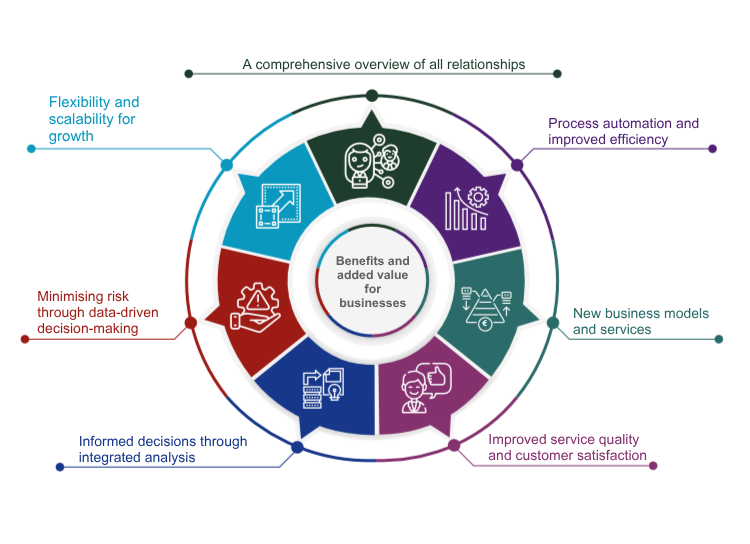
Holistic relationship management
xRM extends the traditional CRM approach by including all relevant relationship partners, such as suppliers, partners, employees, investors, authorities, or even physical objects such as machines or real estate. The centralized management of these complex networks, including hierarchies, roles, and interactions, enables a holistic view of all company relationships and significantly improves coordination as well as cross-departmental collaboration.
More efficient collaboration and communication
As a central information platform, xRM supports both internal and external communication. The structured exchange of data, documents, and tasks promotes cross-functional collaboration and reduces the effort required for manual coordination.
Optimized business processes
xRM systems enable the automation and standardization of recurring processes. This includes everything from onboarding new partners and managing maintenance contracts to controlling individual workflows. The ability to involve all stakeholders in processes helps avoid media discontinuities and close process gaps. The result is measurable efficiency gains and cost reductions.
Better data usage and analysis
A modern xRM system offers powerful analysis and reporting functions that enable companies to systematically evaluate their relationship data. Whether interaction histories, performance indicators, or trends, these evaluations make it possible to make informed decisions and further develop business strategies in a targeted way.
Increased customer satisfaction and loyalty
The consolidated view of customer relationships enables personalized, needs-based support. This not only increases customer satisfaction, but also opens up potential for cross-selling and upselling through targeted engagement at the right moment.
Flexibility and adaptability
xRM systems are characterized by their flexible architecture. They can be tailored individually to the requirements of different industries and company sizes. Thanks to modern interface technologies (APIs), seamless integration into existing IT landscapes such as ERP, DMS, or BI systems is also easily possible.
Risk minimization
By systematically recording and monitoring all relevant relationships, risks can be identified at an early stage, whether in the supply chain, project environment, or regulatory context. xRM thus strengthens strategic agility and supports active risk management.
Use cases for xRM
Industry-specific applications: Tailored relationship management
Thanks to their high adaptability, xRM systems are ideal for industries whose core processes go beyond pure customer relationship management and include a wide variety of relationship types. While a standard CRM often reaches its limits when it comes to mapping specific industry relationships and processes, xRM offers the flexibility to model these precisely:
Healthcare
Management of relationships with patients (including medical history and treatment plans), payers (billing processes), specialists (referrals and cooperation), and nursing staff (deployment planning). A CRM would be too strongly focused on acquiring and supporting "customers" and would not adequately map the complex relationships in healthcare.
Educational institutions
Management of students (study progress, exams), lecturers (contracts, teaching materials), alumni (network maintenance, donations), and partner institutions (cooperation agreements). A CRM would focus primarily on the "customer relationship" with prospective students and neglect the many other relationships involved.
Real estate industry
Management of tenants (lease agreements, maintenance), owners (management agreements, billing), service providers (order management), properties (master data, condition), and contracts (lease, purchase, and service agreements). A CRM would primarily focus on acquiring and managing buyers or tenants and would not comprehensively support property management or relationships with other stakeholders.
Insurance
Management of broker networks (commissions, training), claims management (processing workflows, assessors), and contract processes (policy administration, renewals). A CRM would mainly concentrate on the relationship with policyholders in terms of sales and service and would neglect the complex relationships with brokers and within claims management.
Non-profit organizations
Relationship management with donors (donation history, funded projects), members (administration, events), volunteers (deployment planning, communication), and funding institutions (applications, reports). A CRM would focus heavily on the "customer relationship" with donors and would not adequately map the other important relationships and processes.
Practical benefits: A high degree of customization beyond pure customer management functions, centralized data management for all relevant relationships and objects, and the ability to efficiently map and optimize industry-specific core processes. The value lies in the comprehensive representation of the specific relationship landscape and the support of the industry's operational processes.
Public sector: xRM in authorities and public administrations
Public institutions benefit enormously from the possibilities of an xRM system because their tasks go far beyond pure customer relationship management. While a traditional CRM is primarily geared toward interaction with (potential) customers in the sense of a business relationship, xRM addresses the need to manage diverse relationships and processes that are not primarily sales-oriented:
Case management for applications, approvals, or funding programs:
xRM enables the mapping of complex approval processes involving numerous internal and external stakeholders (e.g. specialist departments, assessors, applicants). In contrast, a CRM typically focuses on the sales funnel and lead tracking.
-
Management of contacts with citizens, companies, and institutions:
xRM centralizes communication and interaction with a broad range of stakeholders whose relationship with the authority is not based on a purchase, but on rights, obligations, or services. A CRM primarily concentrates on customer contacts in the context of sales and marketing. -
Workflow-supported processing including deadline and status control:
xRM supports compliance with statutory deadlines and internal processing times across different specialist departments and offers a transparent status view for all stakeholders. CRM workflows are generally geared toward sales and marketing processes. -
Audit-proof documentation and transparent traceability:
xRM ensures complete documentation of all relevant steps and decisions in terms of compliance and accountability toward citizens and supervisory authorities. Documentation in a CRM is primarily focused on customer history and sales activities.
Practical benefits: More efficient administrative processes, better communication with external stakeholders beyond pure customer interaction, digital traceability of public-sector processes, and improved citizen satisfaction through transparent and accelerated procedures. The focus here is not on increasing revenue, but on service quality and the efficiency of public administration.
Conclusion
xRM represents a paradigm shift in the way business relationships are managed. While traditional CRM systems are focused on customers, xRM extends this approach to universal, centralized relationship management that integrates all business-relevant stakeholders, objects, and processes. The increasing complexity and connectivity within organizations make this holistic approach not only useful, but strategically essential.
With its configurable platform architecture, seamless integration into existing system landscapes, and comprehensive data and security concepts, xRM offers a future-proof solution for organizations of all industries and sizes. Whether in industry, healthcare, education, real estate, or the public sector, xRM creates the technological and organizational foundation for efficient, transparent, and resilient business processes.
Companies that want to think beyond traditional CRM structures and systematically capture and manage all relationships will find in xRM a powerful tool that supports not only operational efficiency, but also strategic management, risk minimization, and innovation capability. xRM is therefore not a replacement for CRM, but a logical evolution – with the potential to sustainably advance digital transformation in relationship management.