By now, almost everyone is familiar with the rating of products, services, companies, doctors, museums, restaurants, etc. using stars, points, or written reviews. The list could go on indefinitely. Positive reviews generally lead to more customers or visitors. Negative reviews can quickly become a disaster for a company or organization. This is a fact that criminals now also exploit by threatening to post large numbers of negative reviews in order to extort money.
Review management plays a crucial role in the success of companies. Review management software is a powerful tool that helps companies collect, analyze, and respond to customer feedback. These software solutions help improve a company’s image, increase customer satisfaction, and ultimately boost revenue.
For small and medium-sized enterprises, the relevance of this software is particularly high, because these enterprises often face the challenge of ensuring high customer satisfaction and remaining competitive while working with limited resources. Review management software offers a cost-effective way to strengthen customer loyalty and improve their market position.
Benefits for small and medium-sized enterprises
Implementing review management software offers small and medium-sized enterprises numerous benefits that not only increase customer satisfaction, but also improve operational efficiency and create competitive advantages.
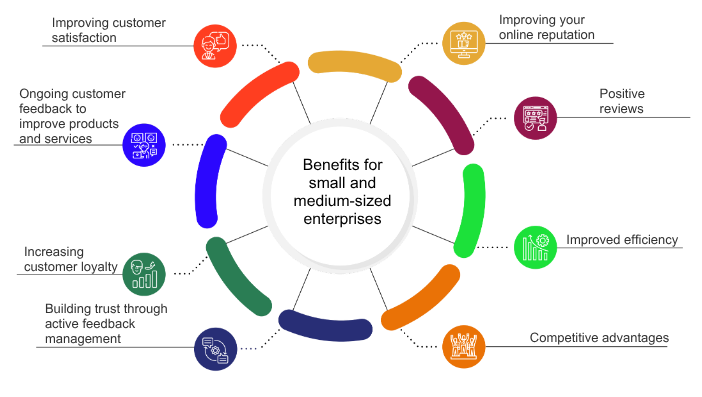
Increasing customer satisfaction
One of the core functions of review management software is the collection and analysis of customer feedback. Through systematic monitoring and rapid responses to customer inquiries and complaints, small and medium-sized enterprises can significantly increase customer satisfaction. By proactively responding to customer needs, they create a positive customer experience and increase the likelihood of repeat purchases and recommendations.
Continuous customer feedback for improving products and services
The continuous collection of customer feedback enables small and medium-sized enterprises to consistently optimize their products and services. Evaluating feedback helps identify weaknesses. Once a company knows the weak points of its product or service, targeted improvement measures can be initiated. In this way, company offerings can be continuously adapted and further developed, which in turn allows customer needs to be met more effectively.
Increasing customer loyalty
By actively managing reviews, small and medium-sized enterprises can build a closer relationship with their customers. When customers see that their opinions and suggestions are taken seriously and implemented, they feel valued and are more likely to remain loyal to the company. This strengthens customer loyalty and ensures a long-term business relationship.
Building trust through active feedback management
Transparency and openness in dealing with customer feedback make a significant contribution to building trust. small and medium-sized enterprises that actively and publicly respond to reviews signal to their customers that they value their opinions and are always striving to improve. This creates a positive company image and promotes trust in the brand.
Improving online reputation
Online reviews are read by other consumers and influence their purchasing decisions. Review management software supports small and medium-sized enterprises in monitoring and improving their online reputation. By encouraging positive reviews and strategically addressing negative feedback, companies can strengthen their reputation online and convince potential customers.
Positive reviews and their influence on the company image
Positive reviews have a direct impact on a company’s image. They serve as social proof and build trust among potential customers. Review management software helps encourage satisfied customers to leave reviews. This maximizes the number of positive responses. A positive company image leads to higher conversion rates and increased revenue.
Increasing efficiency
Automating many review management processes leads to a significant increase in efficiency. By using review management software, small and medium-sized enterprises can save time and resources because manual tasks such as collecting and evaluating feedback as well as creating reports are automated. By integrating tools for collecting customer opinions across various channels, such as emails, social media, and review portals, a comprehensive data foundation is created that helps support sound decision-making.
Competitive advantages
small and medium-sized enterprises that use review management software gain a decisive competitive advantage. By responding quickly and effectively to customer feedback, they can adapt better to market requirements and stand out from the competition. The continuous improvement of products and services helps increase competitiveness.
These functions are important for review management
For effective review management, it is important that the software includes a range of crucial features. These features make it possible to collect, analyze, and respond to customer feedback efficiently.
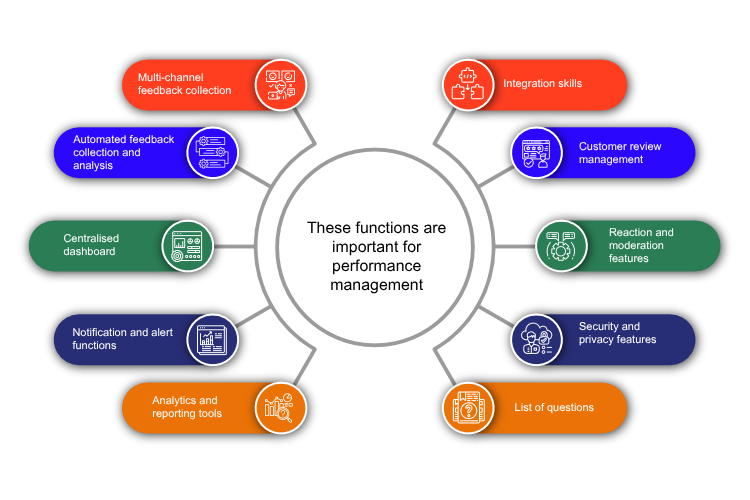
Multi-channel feedback collection
The ability to collect feedback from different channels such as email, social media, review portals, and direct customer surveys is crucial. Comprehensive data collection ensures that all relevant customer opinions are captured and taken into account.
Automated feedback collection and analysis
Automation saves time and resources. The software should be able to capture and analyze feedback automatically. This includes identifying keywords, sentiment analysis, and the creation of reports that provide clear insights into customer opinions.
Centralized dashboard
A centralized dashboard provides a clear overview of all collected reviews and feedback. It enables easy navigation and quick access to relevant information. Dashboards should be customizable to reflect specific needs and priorities.
Notification and alert functions
The software should include notification and alert functions that inform the company immediately about new reviews or urgent issues. These real-time notifications help companies respond quickly to customer feedback and resolve problems promptly.
Analysis and reporting tools
Powerful analysis and reporting tools are essential for making informed decisions. These tools should deliver detailed reports and analyses that reveal trends, identify weaknesses, and measure the success of actions taken.
Integration capability
The ability to integrate with other systems and platforms is crucial. This may include CRM systems, email marketing tools, social networks, and other business software. Seamless integration enables a smooth flow of information and comprehensive use of data.
Customer review management
The software should offer tools to encourage customers to leave reviews. This can be done through automated emails, surveys after purchases, or incentives such as discounts and prize draws. Positive reviews can thus be encouraged in a targeted manner.
Response and moderation functions
Effective review management also includes the ability to respond to customer feedback quickly and professionally. The software should offer functions for managing responses and moderating reviews in order to ensure constructive communication with customers.
Security and data protection functions
Because customer feedback often contains sensitive data, the software must meet strict security and data protection standards. This includes compliance with data protection laws, secure data storage, and protection against unauthorized access.
Question catalog
The software should offer the option of creating individually customizable question catalogs. This enables companies to create targeted surveys that cover specific aspects of customer opinions and experiences. A flexible question catalog helps collect detailed and relevant information that is essential for the continuous improvement of products and services.
Tips for selecting review management software
Selecting the right review management software is a crucial step for small and medium-sized enterprises in efficiently managing and using customer feedback. The following tips will help you find the right software solution for your needs.
Needs analysis and requirements specification
The first and most important step when selecting review management software is to conduct a thorough needs analysis.
-
Goals and priorities
Clearly define which goals you want to achieve with the review management software. These could include goals such as increasing customer satisfaction, improving online reputation, or optimizing products and services.
-
Feedback channels
Determine which channels you want to use to collect feedback (e.g. email, social media, review portals, direct surveys), or through which channels you most frequently receive feedback. The review management or feedback software should then support these feedback channels.
-
Feedback types
Identify the types of feedback that are relevant to your company, such as product reviews, customer satisfaction surveys, or service feedback.
-
Department requirements
Determine the specific requirements of the various departments that will use the software. Sales, marketing, customer service, and product development may have different needs that must be taken into account.
-
Requirements specification
Create a requirements specification document! A requirements specification is a document that describes in detail a client’s requirements and expectations for a project or product. It lists the functional requirements together with a detailed description of the functions that the review management solution should fulfill.
User-friendliness
The user-friendliness of the software is a decisive factor for its acceptance and long-term success. The software should be intuitive and easy to use. A user-friendly interface makes it easier for employees to use the software effectively and encourages customers to provide feedback. Test the software before purchasing to ensure that it meets the needs of its users.
Integration
The review management software should work seamlessly with your existing systems. Check whether the software can be integrated into your current systems such as CRM (Customer Relationship Management) and ERP (Enterprise Resource Planning). Smooth integration facilitates data exchange and improves the efficiency of your business processes.
Scalability
Choose software that can grow with your company. Make sure the software is scalable and can adapt to your company’s future requirements. This means that it should be expandable both for a growing volume of feedback and for new functionalities.
Costs and budget
The cost of the software should be proportionate to the functions and benefits offered. Analyze the software’s value for money and pay attention to costs such as license fees, maintenance costs, or costs for additional functions. Prepare a detailed budget and compare different providers in order to find the best solution for your company.
Customer support and training
Good customer support and comprehensive training options are important for the successful implementation and use of the software. Find out about the provider’s customer support, including the availability of support services (e.g. phone, email, live chat) and the quality of the training offered. Reliable support and comprehensive training help you use the software effectively and solve problems quickly.
Conclusion
Review management software is of crucial importance for small and medium-sized enterprises in order to remain competitive. These software solutions offer numerous benefits, such as increasing customer satisfaction, improving online reputation, and increasing efficiency through automation. For small and medium-sized enterprises working with limited resources, review management software is a cost-effective way to strengthen customer loyalty and improve their own market position. With the right functions and careful selection, companies can respond quickly and effectively to customer feedback, continuously improve their products and services, and thereby gain decisive competitive advantages. Invest in suitable review management software to better meet your customers’ needs and ensure long-term success.