Implementing an Information Security Management System (ISMS) is a logical step for many organisations. Customer expectations are rising, regulatory requirements are becoming more demanding, and information security is no longer something to be managed in isolated measures. It needs to be approached systematically.
In practice, however, it quickly becomes clear that implementing an ISMS is far more than a formal compliance exercise or a purely IT-driven project.
Many implementation initiatives lose momentum because responsibilities are not clearly defined, relevant information is scattered across multiple systems, or the ISMS is perceived as an additional administrative burden in day-to-day operations. Instead of becoming an effective management framework, the result is often a “paper ISMS” that is prepared for audits but has only limited impact in everyday business.
In most cases, ISMS implementation does not fail because the concept itself is flawed or because organisations lack knowledge of the relevant standards. More often, recurring practical challenges make both implementation and ongoing operation unnecessarily difficult. The right software will not solve these issues on its own, but it can play an important supporting role by structuring workflows, increasing transparency, and making implementation far easier in practice.
The following article highlights seven common pitfalls in ISMS implementation and explains how organisations can address them effectively from both an organisational and a technological perspective.
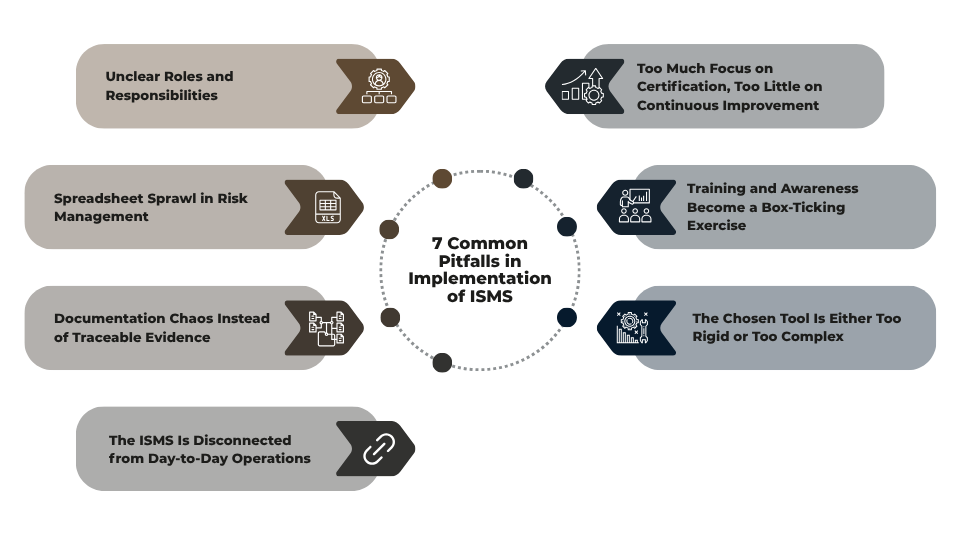
Pitfall 1: Unclear Roles and Responsibilities
An ISMS is not the responsibility of the IT department alone. Business units, management, HR, data protection, compliance, and quality management should all be involved. This is also where one of the biggest challenges often arises: many stakeholders are involved, but it is not always clearly defined who is responsible for what.
If it remains unclear who is responsible for risk assessments, tracking actions, approving policies, or compiling evidence, delays and coordination issues are almost inevitable. Tasks are passed between departments or end up resting with a few individuals. As a result, security management loses accountability and quickly becomes a secondary concern in day-to-day operations.
ISMS software can help by creating transparency. Role and permissions models, task workflows, deadlines, reminders, and escalation mechanisms make responsibilities easier to define and track. This provides clarity on who owns which task and where approvals or decisions are required.
What matters in practice:
An ISMS requires clearly defined ownership so that security-related tasks do not get lost in everyday business.
Pitfall 2: Spreadsheet Sprawl in Risk Management
Especially in the early stages of ISMS implementation, many organisations rely on spreadsheets, standalone files, and decentralised lists. This is understandable, but it quickly becomes a problem in risk management. As soon as multiple people work with different files, inconsistencies emerge: different versions, varying assessment criteria, and an incomplete overall view.
The result is that risks may be documented, but they are no longer managed consistently. Actions are not assigned clearly, deadlines are missed, and changes become difficult to trace. This creates challenges not only for internal management, but also for audits, because there is no reliable single source of truth.
Suitable ISMS software can help centralise risk management. A shared risk register, standardised assessment methods, version histories, and links between risks, actions, and owners create greater consistency. This improves visibility while also reducing coordination effort.
What matters in practice:
The more risk management depends on isolated files, the harder it becomes to build a robust and audit-ready ISMS.
Pitfall 3: Documentation Chaos Instead of Traceable Evidence
Documentation is a core element of every ISMS. Problems arise when policies, process descriptions, logs, training records, and action lists are stored in different places. In many organisations, this information is spread across file shares, emails, wikis, project folders, or local drives.
This often only becomes visible when documents are needed at short notice. Teams then start searching for the latest version, the correct approval status, or reliable evidence. This costs time, complicates audits, and reduces acceptance of the ISMS because it is seen as cumbersome and difficult to navigate.
The right ISMS software helps by providing centralised document management, version control, and approval workflows. This makes it clear which version is current, who made which changes, and which documents have already been approved. Scattered information is turned into a structured and manageable documentation base.
What matters in practice:
The issue is rarely the amount of documentation. The real problem is the lack of structure, governance, and easy retrieval.
Pitfall 4: The ISMS Is Disconnected from Day-to-Day Operations
An ISMS only creates real value when it is linked to existing business processes. In practice, however, it is often introduced as a standalone initiative running alongside IT service management, ticketing, asset management, HR, or document management. This typically leads to duplicated effort and fragmented information.
When actions, risks, and evidence are maintained in different places, efficiency suffers. At the same time, acceptance across business functions declines because the ISMS is seen as an additional administrative layer. Security management then feels like something separate from the organisation rather than an integrated part of it.
This is where solutions with interfaces, APIs, or standard integrations are particularly valuable. The better the ISMS can connect with existing systems, workflows, and data sources, the more likely it is to be accepted and used in day-to-day operations.
What matters in practice:
An ISMS should support and structure existing processes, not run in parallel to them.
Pitfall 5: Too Much Focus on Certification Too Little on Continuous Improvement
Many organisations begin implementing an ISMS with a clear goal in mind, such as preparing for an audit or certification. That is entirely understandable, but it can also lead to a common mistake: once the audit has been passed, the topic loses visibility and momentum.
Actions remain open, reviews are postponed, policies are updated only selectively, and risks are no longer developed consistently. In this situation, the ISMS is no longer treated as an ongoing management system, but rather as a project with a fixed end point. This is precisely where it starts to lose its effectiveness.
An effective ISMS requires continuous improvement. Open actions need to be tracked, deadlines monitored, and progress made visible. Software can support this through action tracking, reminders, escalation workflows, and dashboards for management and responsible stakeholders.
What matters in practice:
An ISMS does not end with the initial audit. It must be maintained, reviewed, and continuously developed.
Pitfall 6: Training and Awareness Become a Box-Ticking Exercise
Employees are a critical factor in information security. Yet in many organisations, training and awareness measures are handled largely as a formal requirement. There are mandatory training sessions, standard materials, and attendance records, but often little connection to specific roles, risks, or business areas.
As a result, it remains unclear whether the right content has reached the right target groups. Evidence is often incomplete as well. Who was trained and when? What content was covered? Which refresher activities are due? And how can effectiveness be assessed?
Suitable software can help make awareness activities more structured. This includes planning training sessions, assigning them to roles, documenting attendance and completion status, and linking them to risks or incidents. This makes training easier to manage, monitor, and demonstrate.
What matters in practice:
Awareness only becomes effective when it is targeted, repeatable, and clearly traceable.
Pitfall 7: The Chosen Tool Is Either Too Rigid or Too Complex
Not every ISMS software solution is the right fit for every organisation. A common mistake during software selection is choosing either a very comprehensive but heavyweight platform or a tool that is too simple and quickly reaches its limits as requirements grow.
Overly complex systems often come with significant implementation effort, training needs, and administrative overhead. Simpler tools may work initially, but they often fail to provide a sustainable foundation for expanding processes, additional sites, or increasing compliance demands. Both scenarios can make implementation more difficult than it needs to be.
What matters most is not whether a solution offers the longest feature list, but whether it fits the organisation, its maturity level, and its development path. In many cases, modularity, adaptable workflows, and scalability are more important than the largest possible range of functions.
What matters in practice:
The right solution is not necessarily the biggest one, but the one that supports the organisation effectively and can grow with its requirements.
Practical Advice: What Organisations Should Look for When Selecting ISMS Software
Organisations that want to avoid common implementation mistakes should not focus on feature lists alone when selecting ISMS software. What matters far more is how well the solution supports the organisation in daily practice.
Key questions include:
-
Can roles, tasks, and approvals be mapped transparently?
-
Can risks, actions, and documents be managed centrally?
-
Can workflows be adapted flexibly without major technical effort?
-
What integrations with existing systems are available?
-
How well does the solution support ongoing reviews and action tracking?
-
Is the software appropriate for the organisation’s size and level of maturity?
-
Can the solution be expanded sensibly as requirements increase?
Organisations benefit most from solutions that do more than simply document information. The real value lies in creating transparency and making operational control easier. This is exactly where a structured comparison can add value.
Conclusion: An Effective ISMS Requires Structure, Accountability, and the Right Tools
In practice, ISMS implementation rarely fails because organisations do not understand the importance of information security, and only rarely because of the standards themselves. Much more often, progress is slowed by unclear responsibilities, fragmented information, insufficient follow-up, and unsuitable tools.
Organisations that identify these pitfalls early create better conditions for an ISMS that is not only formally in place, but also effective in day-to-day business.
The right software can make a significant contribution here. It does not replace clear ownership or robust processes, but it can help reduce complexity, centralise information, and support a more structured approach to managing information security.