Introduction: Why Integration Matters
Online configurators for printed products, cars, bicycles, kitchens, and many other offerings are now widely used by companies that provide highly customizable products or services. In most cases, these solutions are powered by CPQ software (Configure, Price, Quote). These systems help sales teams manage complex configurations, calculate pricing, and generate accurate quotes quickly and efficiently.
However, the full potential of CPQ platforms is only realized when they are seamlessly integrated into existing ERP, merchandise management, and CRM (Customer Relationship Management) systems, enabling a smooth and reliable flow of data. This integration is essential because it creates a consistent data environment in which all relevant information is readily available across departments.
This improved data consistency typically leads to greater efficiency, while a unified data foundation also provides a stronger basis for decision-making across the organization. Without this kind of integration, companies often face challenges caused by isolated data silos and manual processes, resulting in errors and delays.
Technical Challenges and Solutions
Integrating CPQ software into existing software environments is not a simple task and involves a range of technical challenges. One of the biggest hurdles when adding software to an established system landscape is data consistency. Different systems often store data in different formats and database structures, which makes synchronization significantly more difficult. Careful planning and data mapping are therefore essential to ensure that all systems work with the same data set.
Another challenge is system compatibility. Older ERP, merchandise management, or CRM systems may not provide the interfaces or APIs required for seamless integration. In such cases, a middleware solution may be needed, possibly as a custom development. Middleware can then serve as a bridge between the systems and enable reliable data exchange.
Security is another critical issue. Data exchange between different systems must be secure in order to protect sensitive company and customer information. Robust security protocols and encryption methods are necessary to prevent unauthorized access.
To address these technical challenges, comprehensive testing and a phased implementation of CPQ software are highly recommended. Companies should run pilot projects and introduce the integration step by step in order to identify and resolve potential issues at an early stage.
Benefits of Integration
Integrating CPQ software into ERP, merchandise management, and CRM systems offers numerous benefits that positively affect both business processes and the customer experience.

Improved data consistency
CPQ software that is well integrated into the company’s IT landscape ensures that data from different systems is consolidated, resulting in greater data consistency. This means that all departments, from sales and marketing to production, inventory management, and accounting, can access the same up-to-date information. As a result, the likelihood of errors caused by inconsistent or outdated data is significantly reduced.
Increased efficiency
Another major advantage of a well-integrated system is the elimination of redundant data and manual entries, which increases the overall efficiency of business processes. Employees can focus more on value-adding activities because they spend less time entering and verifying data. In addition, processes can be automated, resulting in faster handling of customer inquiries and quotations.
Better customer experiences
By seamlessly integrating CPQ software, companies can respond to customer inquiries more quickly and accurately. Customers receive consistent, reliable quotes through the CPQ platform and benefit from a more coherent communication experience. Customer interactions can also be personalized, which helps increase both customer satisfaction and loyalty.
Best Practices
To successfully integrate CPQ software into existing ERP, merchandise management, and CRM systems, companies should follow a number of proven best practices.
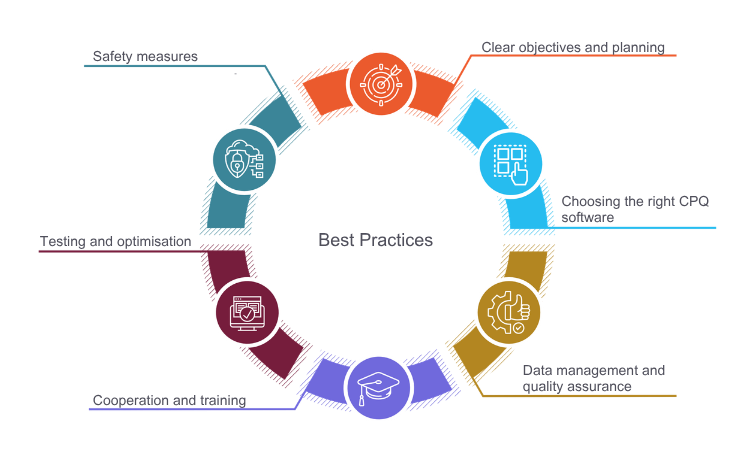
Clear objectives and planning
Before beginning the integration of a new or additional software solution, companies should define clear goals and requirements. This includes identifying the systems to be integrated, the desired functionality, and the expected outcomes. Detailed planning helps structure the integration process and identify potential obstacles at an early stage.
Selecting the right CPQ software
Choosing the right CPQ software is critical. Companies should ensure that the CPQ solution provides the necessary interfaces and integration capabilities to communicate seamlessly with existing ERP and CRM systems. Scalability and flexibility should also be taken into account so that future requirements can be met. Creating a requirements specification can be highly beneficial when defining expectations and functional needs for CPQ software.
Data management and quality assurance
Successful integration requires a thorough analysis and cleansing of existing data. Companies should ensure that all data is accurate and consistent before it is migrated into the new system. Existing data should always be backed up, and that backup should also be tested. The most recent backup is of little use if it does not work. Regular data reviews and quality checks are equally important to maintain data integrity over time.
Collaboration and training
Integrating CPQ software requires close collaboration between the various departments within the company. All relevant stakeholders should be involved in the integration process. This ensures that their requirements and expectations are recognized and, wherever possible, taken into account. In addition, comprehensive employee training is essential to help teams work confidently with the new systems and processes.
Testing and optimization
Test, test, test. To ensure that the integration runs smoothly, companies should carry out extensive testing. These tests should include both functional testing and load testing in order to evaluate the performance of the integrated systems. After implementation, the system should be continuously monitored and optimized to ensure that the overall IT environment operates efficiently and reliably.
Security measures
Data security is a key consideration when integrating CPQ software. Protecting sensitive customer and company data must be the highest priority. Companies should ensure that all security protocols and encryption methods are in place to safeguard data exchange between systems. Regular security reviews and audits are necessary to identify and address potential vulnerabilities.
Conclusion
Integrating CPQ software into existing ERP and CRM systems is a key step toward improving efficiency and accuracy throughout the sales process. Although the integration process involves technical challenges, the benefits of improved data consistency, greater efficiency, and better customer experiences provide substantial added value for companies. By following best practices and planning carefully, organizations can implement the integration successfully and benefit from its advantages over the long term.