Introduction to CPQ Software and Its Importance
Efficiency is one of the fundamental drivers of business success. Companies that offer complex products and services often face the challenge of configuring them quickly and accurately, calculating prices, and generating quotes. This is where CPQ software (Configure, Price, Quote) comes into play. A CPQ solution supports sales teams by automating and simplifying complex sales processes. It typically provides a platform on which products can be configured, prices calculated, and quotes created.
The importance of CPQ software for businesses lies in its ability to accelerate the sales process, reduce errors, and at the same time increase customer satisfaction. Without CPQ software, preparing a quote for a complex product can sometimes take days or even weeks. This naturally depends on the complexity of the product or service in question. With the help of dedicated software, this process can usually be reduced to just a few minutes. With the same number of sales staff, this significantly increases the number of quotes that can be generated.
Current State of the Technology
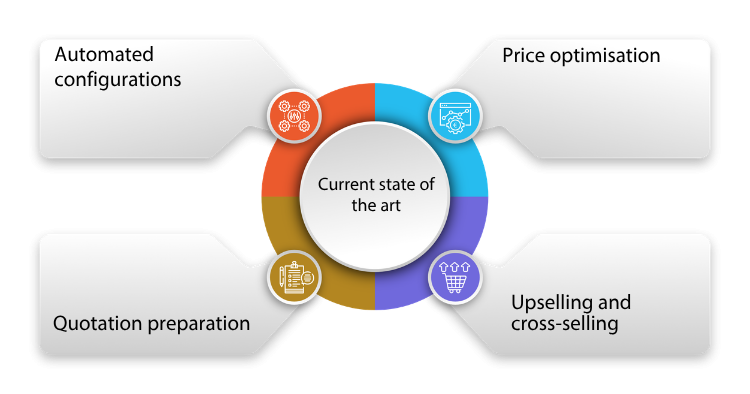
AI is not only used in robotics, text generation, image creation, autonomous driving, and similar fields. Artificial intelligence also enhances numerous processes, analyses, and evaluation capabilities in CPQ software.
Automated configurations
AI-based CPQ systems use algorithms to solve constraint satisfaction problems. AI can ensure that all configuration rules are consistently followed, even in highly complex rule sets and configuration constraints. By analyzing historical data such as order data and inquiries, while also taking current trends into account, AI can identify patterns and preferences in order to recommend the most suitable configurations to customers. Using natural language processing, artificial intelligence can also understand customer requirements and translate them into technical specifications, improving usability and making the configuration process easier.
Price optimization
For price optimization, AI can analyze real-time data. These analyses may be based on factors such as market conditions, demand, customer segments, and competitor activity. With predictive models, AI can forecast future pricing developments and customer demand. This allows companies and sales teams to make proactive pricing adjustments. In addition, AI can identify customer segments and develop personalized pricing strategies based on the specific values and willingness to pay of different groups. All of these measures and capabilities can help maximize profitability.
Quote generation
Quote generation can also be automated and improved with AI. AI-based software can learn from predefined rules and historical data. Quote documents can be tailored to individual requirements and preferences and then created automatically. By using AI, it is also possible to identify potential risks and inconsistencies in quotes and provide recommendations for mitigating those risks. Overall, this can significantly accelerate the sales cycle.
Upselling and cross-selling
Based on purchase history and customer behavior, AI can suggest or recommend additional products or services that complement the current offer well (cross-selling) or offer upgrades (upselling). By analyzing customer interactions and patterns, AI can predict which products or services may be of interest to a customer. The software can then make proactive sales recommendations.
Future Outlook
The integration of artificial intelligence into CPQ software will continue to advance. In the future, AI-driven predictive analytics will allow companies to forecast sales trends and fluctuations in demand more accurately. For example, future market prices and competitive situations can be anticipated more effectively. In addition, CPQ systems will become increasingly capable of adapting automatically to changes in product portfolios and configuration rules. As AI continues to evolve, products and services will be configurable in real time based on live data.
AI will also be able to tailor offers to the individual needs and preferences of each customer based on purchase history, behavioral patterns, and demographic data. In the future, CPQ systems will likely be able to assemble dynamic product and service bundles that best match the specific requirements and preferences of each customer.
In the future, voice assistants and chatbots will be able to answer customer inquiries in real time, explain configuration options, and generate quotes instantly. Customers will very likely be able to communicate their requirements and preferences verbally. Voice assistants and chatbots will also be able to provide 24/7 support, allowing customers to access information and request quotes not only during normal business hours, but at any time.
Benefits and Challenges
Benefits of Using AI in CPQ Software

Greater efficiency and accuracy
One of the biggest advantages of AI in CPQ solutions is its ability to process huge volumes of data and complex rule sets at high speed. AI is simply faster and more precise when it comes to determining configurations and generating quotes. Many time-consuming tasks in the sales process can be automated through AI, leading to significant time and cost savings.
Better decision-making and personalization
AI-supported analyses deliver valuable insights into customer behavior and market trends, helping sales teams make informed decisions. By analyzing customer data, AI can create personalized offers and recommendations, which increases customer loyalty and satisfaction.
Competitive advantage
Companies that use AI in their CPQ software can respond to customer requirements faster and more accurately, giving them a competitive advantage. Predictive analytics can forecast trends and demand, enabling not only quotes and prices but also inventory levels to be adjusted accordingly, which represents a major strategic benefit.
Challenges of Using AI in CPQ Software
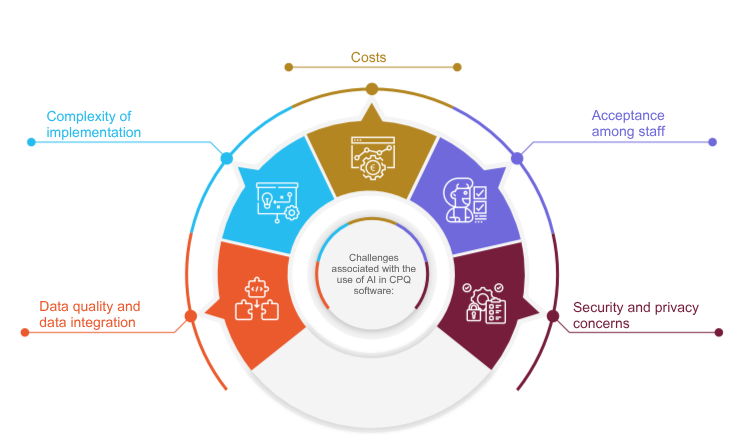
Data quality and data integration
The performance of AI depends heavily on the quality and volume of the underlying data. Integrating and cleansing data from different sources can be a highly complex task. Data quality remains a critical factor in analyses and recommendations generated by artificial intelligence. For this reason, full attention is required during implementation and integration. Incorrect or flawed analyses usually result from a data foundation that is inaccurate or incomplete.
Implementation complexity
Implementing AI-based CPQ software requires careful planning and technical expertise. Companies must ensure that they have the necessary resources and capabilities to integrate AI successfully.
Costs
Developing and implementing AI solutions can be expensive. Depending on the solution, costs may arise for hardware, software, data integration, and staff training. Companies need to weigh these costs against the potential benefits.
Employee acceptance
The introduction of AI-based software may meet resistance from employees, particularly if they fear that their jobs are at risk or are generally critical of change. It is therefore extremely important to provide training and change management programs in order to foster acceptance.
Security and data privacy concerns
The use of AI-powered software requires handling large volumes of sensitive data. Companies must ensure that they implement robust security and data protection measures to safeguard their customers’ data.
Conclusion
The integration of AI-based CPQ software brings about a remarkable transformation of the sales process. With CPQ solutions, complex products and services can be configured more quickly and accurately. Prices and quotes can be created more easily and in less time. The sales cycle is significantly shortened. Companies benefit from greater customer satisfaction and can gain a clear competitive advantage.
A key advantage of AI is its ability to process large volumes of data quickly and accurately, which increases both efficiency and precision. AI-powered CPQ systems analyze historical and real-time data to make accurate predictions, identify patterns and preferences, and thereby develop better sales strategies. These benefits lead to improved decision-making, greater personalization, and faster responses to market changes.
Overall, integrating AI into CPQ software offers substantial benefits that optimize the sales process and provide companies with a strategic advantage. At the same time, it requires careful planning and the provision of the necessary resources in order to overcome the associated challenges and fully realize the benefits.