The Key to Business Success
Collaboration - working together - no company with multiple employees can truly be successful in the long term without good internal cooperation, effective coordination, a regulated flow of information, and efficient task management. But does a company need a separate tool for internal collaboration? What is collaboration software and what advantages does it offer? Does the use of collaboration software depend on the company structure, the approach to projects, or the number of people involved? What reasons are there for companies to invest in collaboration software?
What is Collaboration Software?
Collaboration software is designed to support the management of tasks and projects, promote internal exchange between employees, and centralize and control the overall flow of information and data.
Collaboration tools are used to ensure and optimize good communication and coordination between employees. These tools provide the ideal distribution of tasks and ensure the smooth exchange of messages and data. Collaboration software is diverse and broad in scope. Individual tools can cover very different ranges of functions. All collaboration software solutions support and optimize teamwork. As a rule, collaboration tools are offered as cloud solutions.
What Functions Do Collaboration Tools Offer?
Communication One of the most important functions of collaboration software is communication. For communication purposes, the software generally provides various features for exchanging messages and data, comments, etc. in real time. These include real-time communication via chat (instant messaging), video calls, and comment functions.
Shared Calendar A shared calendar for the team is an important component of collaboration. A shared calendar gives all team members an up-to-date overview of all relevant appointments.
Collaborative Document Editing
Another extremely important function is file sharing or shared access to documents stored in the cloud. This central form of storage and access ensures that everyone has access to the latest shared data and knowledge. At the same time, centrally storing data in the cloud makes it possible to edit texts and spreadsheets simultaneously in real time.
Planning Functions The functionalities of collaboration software generally also include planning functions for management or the project manager. Resources can be planned optimally with the help of the tool, and work processes, project progress, and more can be documented.
Is the Use of Collaboration Software Worthwhile for Every Team Size?
A small company with only a few employees does not necessarily need a collaboration tool. In most cases, coordination between two or three team members can still be handled easily and quickly via email, Excel, etc. However, if the team becomes larger, or if the team is repeatedly made up of different members and perhaps also includes external participants, the use of collaboration software certainly makes sense.
If the number of parallel processes and tasks increases, it is also advisable to use software to optimize processes. From a certain team size or company size onward, it is no longer possible to personally contact all participants for status updates. Sharing centrally stored data then also becomes important. These and other workflows can generally be handled better, faster, and more comprehensively with software.
Five Reasons to Invest in Collaboration Software
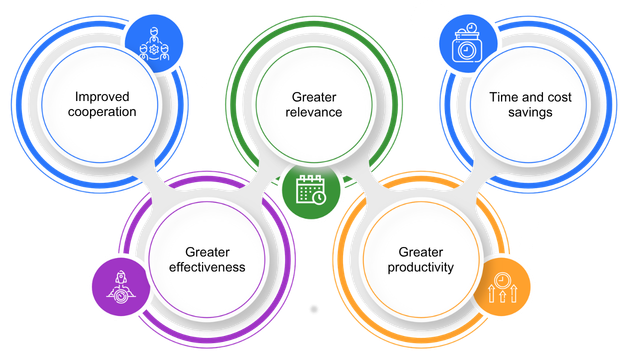
Improved Collaboration
One of the most important reasons to invest in a collaboration tool is already reflected in the name of the software itself - to strengthen and improve "collaboration." These tools enable cross-network, location-independent, and flexible work. You can implement virtual digital teamwork with the help of the software. Regardless of whether team members work in different offices, from home, or while traveling, everyone involved can be reached, access current data, and exchange information in real time.
Greater Efficiency
Collaboration tools support fast and uncomplicated coordination within the company and with external participants. The rapid exchange of information is one of the core functionalities of the software. Coordinating and optimizing work processes generally leads to greater efficiency within the company. The software enables faster access to existing data, greater transparency, and usually also provides simple evaluation options. What matters here is the holistic work structure within the company that is made possible by the use of the software. The introduction of a collaboration tool is usually accompanied by adjustments and restructuring measures that increase overall efficiency in the company.
More Up-to-Date Information
A collaboration system clearly displays all project updates and project statuses so that everyone involved is always well informed about the current status. This promotes realistic expectations and also ensures that possible external project participants can contribute to the project independently. At the same time, a collaboration tool also enables error tracking within the team. Once errors have been identified, they can be avoided in the future.
Greater Productivity
Decisions can be made more reliably and more quickly through the use of collaboration tools. Whether working from home or from otherwise distributed workplaces, project work in many areas is moving toward agile methods. Small teams organize themselves. Project requirements may still be unclear at the beginning. Therefore, constant exchange is necessary in order to make the required adjustments.
Interdisciplinary teams may be assembled only for the current project. In the next project, different team members often work together. The use of collaboration tools is designed precisely for these situations. Projects and processes can be organized, optimized, and handled in an agile way. Collaboration software provides the necessary overview, serves as a communication tool, and increases productivity. Concrete results can be achieved more quickly. Better and more efficient communication generally means that team members can take on more qualified tasks and reach the desired result faster.
Time and Cost Savings
Because everything is documented and stored centrally in a single tool, to-do meetings and status meetings become unnecessary. With a collaboration tool, team members have more time for the actual project work and need less time for organizational matters.
Conclusion
Collaboration software supports teamwork within companies as well as project management. The goal of collaboration tools is to improve knowledge and information management. Communication is especially important in large teams. All project participants always have access to the current status of projects, data, and information, which increases efficiency and saves time and costs.