The development of BIM as a comprehensive concept began in the 1990s with the increasing availability of powerful computers and specialized BIM software. Since then, BIM has continuously evolved and is now an indispensable part of modern construction projects. BIM is revolutionizing the construction industry by replacing traditional, paper-based planning methods with a digital, data-driven approach.
Role of BIM in Modern Construction Planning and Execution
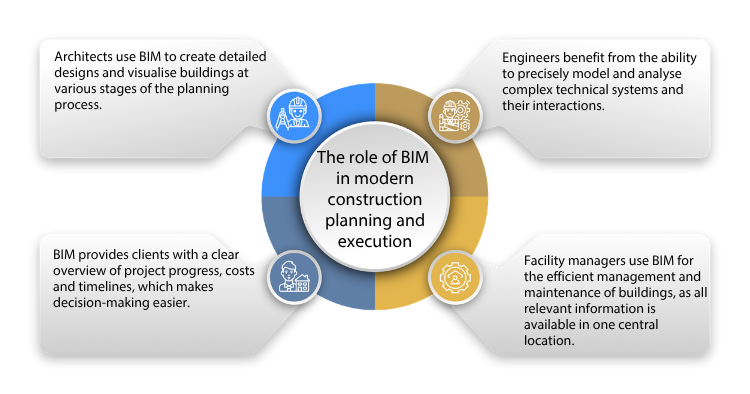
BIM plays a central role in modern construction planning and execution because it provides a precise and comprehensive representation of the planned building. It allows detailed visualization and analysis of construction projects before they are realized. This leads to greater planning accuracy and enables the early identification and resolution of potential problems.
BIM is of great importance to a wide range of stakeholders in the construction industry:
How 3D Modeling Works in BIM
3D modeling is the core of Building Information Modeling (BIM) and enables the creation of detailed, three-dimensional representations of buildings. These models include not only geometric information, but also integrate data on materials, construction phases, technical specifications, and more.
3D models in BIM are created using specialized software that enables the precise representation of all structural elements. Architects and engineers can use the software to accurately model complex structures and their relationships to one another. These models include:

Geometry
Detailed representations of the physical form of the building, including all structural components such as walls, ceilings, floors, and roof structures.
Materials
Specific information about the building materials used, including their properties and specifications.
Technical Specifications
Details of the technical requirements and standards that must be considered during the construction of the building.
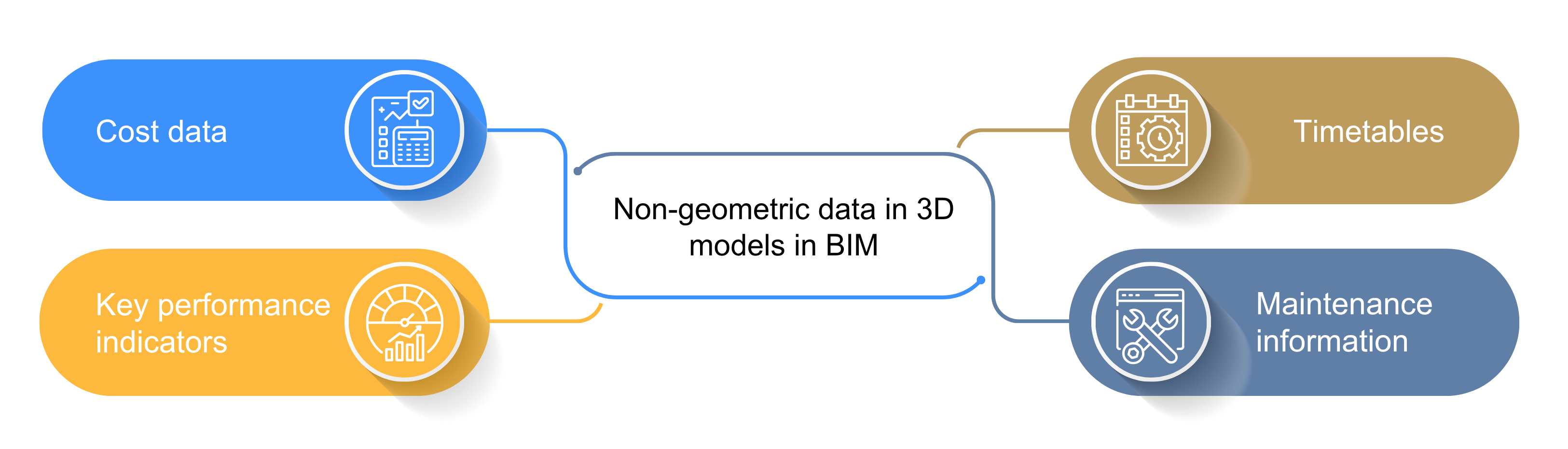
In addition to physical geometry, 3D models in BIM also integrate a wide range of non-geometric data. These include:
Cost Data
Information on the estimated and actual costs of building materials and construction processes.
Schedules
Data on the planned and actual schedules for the various construction phases.
Performance Indicators
Information about the expected and actual performance of the building, for example with regard to energy efficiency and sustainability.
Maintenance Information
Details on the requirements and schedules for the maintenance and upkeep of the building.
Connection Between Construction Project Management and BIM
Integration of Construction Project Management into BIM

Linking schedules, costs, and resource management with 3D models
BIM (Building Information Modeling) is revolutionizing construction project management through the integration of detailed 3D models with comprehensive project management data such as schedules, costs, and resources. This connection enables a holistic and transparent view of the entire construction project.
Schedules
BIM software allows the creation and management of detailed construction schedules. By linking construction phases to the 3D model, construction timelines can be visualized and simulated. This facilitates the identification and resolution of scheduling conflicts and bottlenecks.
Costs
The integration of cost data into BIM models enables precise cost tracking and control. Project owners can monitor budgets in real time and make adjustments to avoid cost overruns.
Resource Management
BIM models contain detailed information about the required materials and resources. This facilitates the planning and procurement of building materials and ensures efficient resource utilization.
Use of BIM in different project phases (planning, execution, operation)

BIM is used in all phases of a construction project and improves efficiency and accuracy in each of these phases.
Planning Phase
In the planning phase, BIM enables the creation of detailed and precise 3D models that take all aspects of the building into account. Architects and engineers can visualize and optimize various design options before construction begins. The integration of schedules and cost data facilitates the creation of realistic and well-thought-out project plans.
Execution Phase
During construction execution, BIM provides a central platform for monitoring and controlling the construction project. Real-time updates and data enable accurate tracking of construction progress and early identification of problems. Site managers can efficiently plan and adjust the use of labor and materials to stay on schedule and control costs.
Operation Phase
After construction is completed, the BIM model becomes a valuable tool for facility management. It contains all relevant information about the building, including maintenance schedules, technical specifications, and repair histories. Facility managers can use the model to plan maintenance work, identify problems early, and improve operational efficiency.
Examples of the Integration of Construction Project Management and BIM
The successful integration of construction project management and BIM can be demonstrated through numerous real-world projects:
Crossrail, London, United Kingdom
The Crossrail project, a new railway line (Elizabeth Line) in London, used BIM for the planning and execution of construction work. BIM models helped coordinate the construction activities and integrate various building techniques. BIM led to improved collaboration among project participants, optimized construction processes, and ensured the early identification and resolution of problems.
The Shard, London, United Kingdom
In the construction of The Shard, the tallest building in Western Europe, BIM was used to improve the planning and coordination of construction processes. The model supported the integration of design changes and helped implement the complex architecture. BIM ensured increased efficiency and accuracy in construction execution, reducing costs and time through improved planning and coordination.
Sydney Opera House, Sydney, Australia
BIM was used for the renovation and facility management of the iconic building. A detailed 3D model helped with the planning of maintenance work and the simulation of future renovation measures. This led to an improved maintenance process, efficient facility management, and also contributed to extending the building’s lifespan.
Benefits of BIM in Construction Project Management
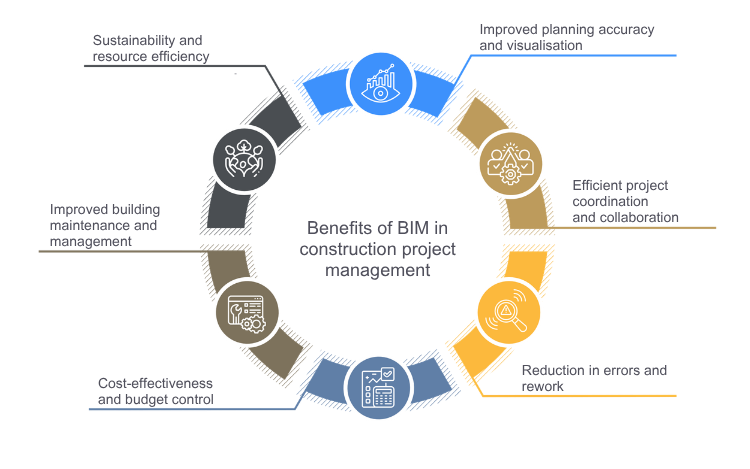
1. Improved Planning Accuracy and Visualization
BIM enables the creation of precise 3D models of construction projects that contain comprehensive information about structural elements and properties. This leads to more accurate planning and helps architects and engineers identify and resolve potential problems at an early stage. The models facilitate decision-making and coordination among stakeholders, as different design options and construction workflows can be visualized and analyzed.
2. Efficient Project Coordination and Collaboration
BIM provides a centralized data platform that gives all project participants access to up-to-date information and ensures data consistency. This promotes collaboration between different disciplines and stakeholders. BIM facilitates the integration of architecture, engineering, and construction through automatic clash detection, which reduces errors and rework. Collaborative modeling fosters cooperation among architects, engineers, and contractors.
3. Reduction of Errors and Rework
BIM enables the early identification and resolution of conflicts through detailed modeling and simulation of various construction workflows, allowing potential clashes and problems to be detected in the planning phase. BIM reduces construction errors through precise planning and detailed models that provide accurate guidance for construction execution. This reduces errors and rework, while continuous monitoring ensures construction quality.
4. Cost Efficiency and Budget Control
BIM enables the precise tracking and control of construction costs through the integration of cost data. This allows accurate cost estimates and real-time adjustments for effective budget control. BIM minimizes rework and delays through precise planning and early problem identification. This leads to more efficient construction processes and on-time project completion.
5. Improved Maintenance and Building Management
BIM models enable the continuous monitoring and management of buildings through the integration of sensors and IoT devices. Real-time data on the condition and use of the building is collected in order to identify maintenance needs early and carry out preventive measures. BIM facilitates facility management by providing access to comprehensive information such as maintenance schedules, repair histories, and technical specifications. This supports the management of the entire building lifecycle, from planning and construction to use and deconstruction.
6. Sustainability and Resource Efficiency
BIM enables the simulation and analysis of energy efficiency and environmental compatibility already in the planning phase, allowing sustainable solutions and materials to be implemented in order to reduce the ecological footprint. Through precise modeling and monitoring, resources are used more efficiently. The detailed models enable accurate planning and optimization of material usage, which reduces the ecological footprint and promotes the sustainability of the construction project.
Conclusion
Building Information Modeling (BIM) has revolutionized the construction industry by replacing traditional, paper-based planning methods with digital, data-driven approaches. BIM provides precise and comprehensive representations of buildings, improves planning accuracy, and enables the early identification of problems. Architects, engineers, project owners, and facility managers all benefit equally from the detailed visualizations and information that BIM provides.
The integration of construction project management and 3D modeling in BIM facilitates the management of schedules, costs, and resources. Across all project phases - from planning and execution to operation - BIM increases efficiency and accuracy. Real-world examples such as the Crossrail project in London and the construction of The Shard demonstrate the practical benefits of BIM.
Overall, BIM promotes improved planning accuracy, efficient collaboration, cost control, and sustainable resource use, making it an indispensable tool in the modern construction industry.