Many companies talk about “time tracking” when they document the working hours of their employees. At first glance, this term seems clear: it records when a person starts work, finishes work, and what breaks are taken. On closer inspection, however, it becomes clear that this only captures part of the relevant information. After all, the question of when work was done is not automatically the same as the question of what the working time was used for.
Time tracking: What exactly does it mean?
Time tracking in everyday business practice usually means documenting the start of work, the end of work, breaks, absences, and time off. It therefore reflects the time frame of a working day without necessarily taking into account which activities were carried out during that time.
In many companies, time tracking is primarily used to meet legal and organizational requirements. These include compliance with working time regulations, management of overtime, documentation of break times, and the basis for vacation and absence accounts. This information is also often relevant for HR administration and payroll accounting.
Classic time tracking therefore answers one central question above all: When and for how long was work performed? For many administrative purposes, that is completely sufficient. For example, anyone who needs to check whether employees have complied with their daily or weekly working hours initially does not need a more detailed evaluation by activity or project.
Time tracking primarily documents the time frame of work.
What is project time tracking?
Project time tracking goes much further than simple time tracking. It does not only record working time as a period, but assigns this time to specific projects, tasks, activities, customers, or cost centers. This makes it visible how the recorded working time is distributed in content terms.
In project-based working environments, this additional information is particularly valuable. Anyone working in IT, consulting, agencies, engineering, or other service-oriented fields usually needs to know exactly how much time is spent on which service. Only then is it possible to assess whether a project is financially successful, whether budgets are being met, or whether the actual effort differs from the original plan.
Project time tracking therefore creates transparency around three especially important aspects: actual effort, resource usage, and the progress of individual work packages. It is therefore not only a documentation tool, but also a central management instrument.
Project time tracking makes visible what working time was used for.
The key difference: when was work done and on what?

The difference between the two approaches can be reduced to two simple questions:
-
Classic time tracking answers: When was work done?
-
Project time tracking answers: What was worked on?
This seemingly small distinction has major practical significance. The information that someone worked eight hours on a given day says nothing yet about how that time was used, whether for customer projects, internal coordination, support, development, or administrative tasks.
This leads to different objectives. While time tracking primarily serves organizational, personnel-related, and labor-law purposes, project time tracking is geared toward business management. It enables evaluations of profitability, utilization, schedule deviations, and actual performance delivered.
Practical example: how the difference appears in daily work
An easy example from everyday business life shows how clear the difference is. An employee works a total of eight hours in one day. In classic time tracking, it may only show that the person worked eight hours and took a thirty-minute break. From an organizational point of view, the day is fully documented.
For project control, however, this information is only of limited use. Only project time tracking shows how those eight hours were actually distributed. For example, it may turn out that three hours were spent on customer project A, two hours on internal development, two and a half hours on support, and half an hour on coordination.
This creates a very different quality of information. Project management can see whether projects are on schedule. Controlling can see which services are particularly time-consuming. Management can assess how productively teams are working and where unnecessary time losses may occur. And toward customers, the services provided can be documented much more clearly.
Only by assigning time to projects and tasks does working time become truly analyzable.
Why companies often need both
Time tracking and project time tracking do not exclude one another; they complement each other. Time tracking provides legal and organizational transparency, for example regarding working hours, absences, and HR processes. Project time tracking, by contrast, provides the necessary insight into what working time was used for, which is crucial for calculation, billing, and resource planning.
Benefits of software for working time tracking
Software for working time tracking offers companies numerous advantages through automation and precise data processing. It replaces error-prone manual methods such as timesheets and ensures legally compliant processes.
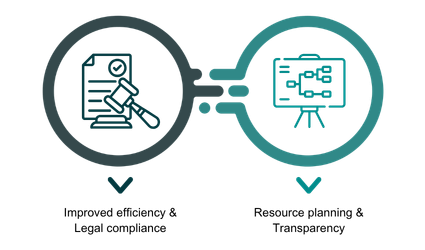
 Efficiency gains & legal compliance
-
Automated recording of work start, end, breaks, and overtime saves time and reduces sources of error.
-
Integration with payroll and accounting eliminates manual data transfer.
-
Cloud storage protects against data loss and enables access from any location.
-
Monitoring maximum working hours, break rules, and ECJ rulings helps avoid fines.
-
Transparent documentation makes audits and collective agreement checks easier.
 Resource planning & transparency
-
Real-time insights into capacity, vacation entitlements, and absences optimize shift planning and staffing reductions.
-
Early detection of overload prevents burnout.
-
Employees can see their time accounts at any time, which promotes fair billing and motivation.
-
Reports show bottlenecks and profitability for better decision-making.
Benefits of software for project time tracking
A well-implemented software solution for project time tracking pays off quickly and creates a reliable basis for planning, controlling, and billing.
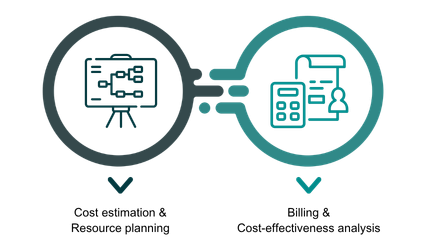
 Effort estimation & resource planning
-
Realistic effort estimates through reliable actual data from previous projects.
-
More precise costing of new projects and better-founded offers.
-
Early visibility of deviations in project phases for timely corrective action.
-
Stabilization of budgets and more targeted deployment of teams.
-
Avoidance of overload and better use of available capacity.
 Billing & profitability analysis
-
Transparent customer billing strengthens trust in the services provided.
-
Valuable key figures for identifying profitable projects and customers.
For which companies is project time tracking especially useful?
Project time tracking is essential wherever working time must be assigned to individual projects or services, for example in agencies, consulting firms, IT and software companies, engineering and development offices, or trades businesses with project-based billing.
Even companies without customer projects benefit: in internal initiatives such as digitalization, product development, or process optimization, project time tracking shows where resources flow and which initiatives require the greatest effort.
Where projects are planned, managed, or evaluated, project time tracking is an important management tool.
What companies should consider when choosing software
When selecting a time tracking or project time tracking solution, it is not only important that time is recorded, but also how this data can be used later. Good software makes it possible to clearly assign time to projects, tasks, activities, or customers.
To ensure that employees use the system consistently, operation must be simple – ideally via mobile apps, web interfaces, and streamlined booking processes.
Meaningful reporting is equally important: reports, dashboards, and flexible filters turn raw data into management-relevant information. Interfaces to ERP, project management, or billing systems ensure smooth data exchange.
In addition, roles and permissions concepts ensure that project management, controlling, or executive leadership each see only the information relevant to them.
What matters is not the mere recording of time, but the quality of the information derived from it.
Conclusion: More than time – a basis for project success
Time tracking and project time tracking are not synonyms, but two different tools with clearly defined responsibilities: classic time tracking documents when work was done and fulfills labor-law and organizational obligations. Project time tracking, on the other hand, shows what time was used for and thus provides the decisive transparency for project controlling, post-calculation, resource planning, and billing.
Especially in project-oriented industries such as IT, consulting, or agencies, both systems complement each other perfectly: together they create a robust data basis that detects deviations early, protects budgets, and optimizes future calculations. Companies that rely only on pure working time data miss out on valuable management information.