Project performance tracking is a crucial step on the path to successful project management. It enables companies to monitor the progress of their projects, use resources efficiently and ultimately achieve their goals. In this article, proven methods and tips for effective project performance tracking are presented, helping companies optimize their projects and complete them successfully.
Setting clear goals and milestones
Defining clear goals and milestones forms the essential foundation for all project performance tracking. Without clear objectives, there is a risk that a project will drift in an unclear direction, which can lead to delays, misunderstandings and inadequate results.
When defining goals and milestones, you should take into account the interests and concerns of all stakeholders, including the project team, customers and management. Milestones are intermediate goals that must be achieved on the way to project completion. They serve to monitor progress and ensure that the project is moving in the right direction. Examples of milestones include, among others, the completion of specific project phases, product versions or deliveries.
In addition to clearly defined goals and established milestones, it is also crucial to remain flexible. Projects can change and goals may need to be adjusted to reflect current requirements or market developments.
Selecting suitable project performance tracking software
The choice of appropriate time and performance tracking software is also crucial for the successful execution of projects. Before deciding on any software, it is important to understand the specific requirements of your projects and your company. What kind of projects do you run? Which features are essential? Do you need time tracking, cost tracking, reporting or integration with other tools? A thorough requirements analysis is key to finding perfectly suitable software.
Ensure that the software meets your requirements and offers a user-friendly interface. Modern project performance tracking tools enable real-time updates, reporting and integration with other project management tools. An overview of typical features and additional tips for selecting suitable project performance tracking software can be found in the SoftGuide software tips for performance tracking.
Consistent documentation and data maintenance
Encourage your team to document working hours, tasks and progress consistently. Define clear standards and guidelines for documenting project performance. Data maintenance should be carried out regularly and be consistent across the entire organization to avoid inconsistencies. Encourage team members to record their work and progress in real time where possible. Modern project performance tracking tools make this possible and help to keep data up to date.
Implement mechanisms to validate recorded data. This can include automatic checks for plausibility and consistency to minimize errors. Ensure that each recorded performance entry can be traced back to specific tasks or milestones. This makes it easier to identify those responsible and analyze performance trends.
Time tracking and resource management
Time tracking and resource management are critical aspects of project performance tracking, as they help increase efficiency and ensure that projects stay within time and budget constraints.
Best practices for time tracking and resource management:
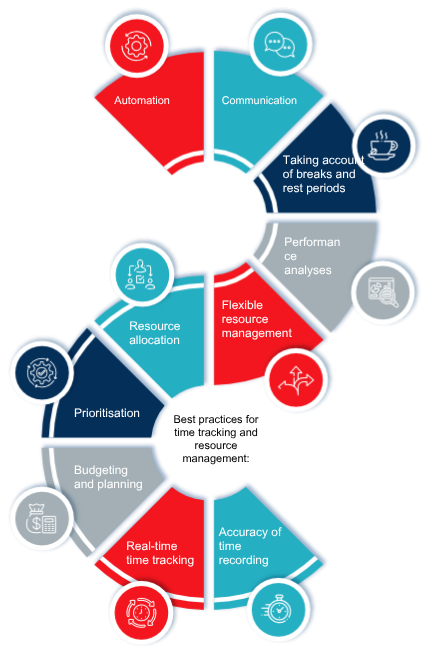
- Accuracy of time tracking
Record working hours and effort as accurately as possible. This means that employees should not only record the total time per day or week, but also for each task or project they work on. This enables detailed analysis and better planning.
- Real-time time tracking
Use tools for real-time time tracking where possible. These make it possible to track progress in real time and respond immediately to delays or bottlenecks.
- Budgeting and planning
Set budgets for time and resources for each project and plan them carefully. Regularly compare the recorded working hours and efforts with the budgets to identify variances.
- Prioritization
Prioritize tasks and projects based on their importance and urgency. This helps to allocate resources more effectively and ensure that critical tasks are completed first.
- Resource allocation
Ensure that resources, including staff and materials, are distributed efficiently and fairly across projects. This prevents overload and bottlenecks.
- Flexible resource management
Maintain flexibility in resource allocation. Priorities may change or unexpected problems may arise. Flexible resource management makes it possible to react quickly to such changes.
- Consideration of breaks and rest periods
Track not only working time but also breaks and rest periods. This helps to take into account employees’ workload and increase productivity.
- Performance analysis
Regularly analyze the data collected on time tracking and resource usage. Identify bottlenecks, overtime or inefficient workflows in order to make improvements.
- Communication
Keep all team members informed about resource utilization. This makes it possible to identify bottlenecks at an early stage and take relief measures.
- Automation
Automate repetitive tasks where possible. This can simplify time tracking and resource management and reduce human error.
Quality assurance and error analysis
Quality assurance and error analysis are crucial steps in project performance tracking to ensure that the data collected is accurate and reliable. This is of vital importance, as inaccurate or faulty data can lead to wrong decisions and inefficient project workflows.
Implement mechanisms to validate recorded data. This can include automatic checks for plausibility and consistency. Conduct regular spot checks to verify the quality of the data collected.
Implement a system for logging errors or inconsistencies in project performance tracking. Train your team in the importance of quality assurance and error prevention. Raise employees’ awareness of how their accurate and reliable contributions enhance the overall efficiency of the project.
If errors occur, perform a root cause analysis to understand the reasons. Use the results of the error analysis to continuously improve the project performance tracking process. Identify weak points and take measures to remedy them. Use standardized forms and templates for documentation to minimize errors due to inconsistent recording.
Training
Offer your team training in effective project performance tracking. This helps increase accuracy and efficiency in capturing project performance. Teach best practices for project performance tracking. This can include the importance of accurate time tracking, consistent documentation and regular data maintenance. Tailor the training to the specific tasks and responsibilities of employees. A team member responsible for time tracking may need different training than someone responsible for cost management.
Provide training materials that team members can refer back to later. These can be manuals, video tutorials or written instructions. Project performance tracking is an ongoing process. Ensure that training is continuous, especially for new employees joining the team.
Reporting and analysis: Gaining insights from project data
Reporting and analysis are crucial steps in project performance tracking, as they help gain valuable insights from the data collected. These insights make it possible to assess project success, plan future projects more effectively and optimize performance.
Use your project performance tracking tool to create custom reports tailored to the specific needs of your company. This can include the display of time spent, costs, progress and other relevant metrics.
Establish a regular reporting schedule that makes it possible to monitor project progress. Depending on project requirements, this may include weekly, monthly or quarterly reports.
Use charts, graphs and visualizations to make complex data more understandable and accessible. This facilitates the interpretation and communication of results. Compare current data with historical data and analyze trends over time.
Identify variances between planned and actual performance indicators. Analyze why variances occur and derive corrective actions. Identify key metrics that best reflect the performance of your projects. These can include cost per unit, schedule compliance, resource utilization or other specific indicators.
Automate reporting where possible. Modern project performance tracking tools often offer the ability to generate and distribute reports automatically. Reports should not only present data but also include interpretations and recommendations for action. The continuous improvement of this aspect of your project management practices helps to carry out more successful projects and ensure long-term business success.
Conclusion
Project performance tracking is an indispensable step in project management. By implementing proven methods and following these tips, companies can not only control their projects more effectively, but also achieve their goals faster and with less effort. Investing in project performance tracking pays off in the long term and helps increase efficiency and competitiveness.
Defining clear goals and milestones is the foundation for effective project performance tracking. Selecting the right project performance tracking software is crucial. It should meet your company’s requirements and be user-friendly. Consistent standards and regular data maintenance are necessary to ensure accurate and reliable data. Automation and validation help minimize errors. Accurate time tracking and efficient resource management are important to keep projects on time and within budget. Reporting and analysis make it possible to gain valuable insights from the data collected.
Overall, project performance tracking is a dynamic process that requires clear structure, careful planning and continuous improvement. When companies implement these proven practices, they can work more efficiently, use resources optimally and ultimately complete their projects successfully.