Virtual events became established during the coronavirus pandemic. After the pandemic, in-person events returned to normal, but for many events, purely virtual or hybrid formats remain a strong option. Participants benefit from the flexibility of these events, and for organizers, digital formats offer increased reach. However, like any other activity on the internet, digital events involve security risks.
For many types of events, participants must register using their personal data. Organizers not only collect attendee data, but important or sensitive information may also be displayed in presentations during digital events. These data are not only essential for the organizer, but also highly attractive to cybercriminals. Registration information, payment details, participants’ personal data, as well as confidential business presentations and other important content should not be compromised through inadequately secured databases, insecure transmission channels and platforms, or insufficient access controls. Frequently underestimated sources of danger also include publicly accessible access codes and weak passwords. If an attack on an event is successful, it may even lead to the disruption of the event.
Event organizers are well advised to conduct a careful risk analysis and take appropriate measures to ensure the security of all digital processes and data flows.
Measures for Greater Security
Use of Secure Event Platforms and Tools
The foundation of cybersecurity for virtual and hybrid events is a suitable event platform or an event management tool. The security of the software solution used has a direct impact on the protection level of the events. When a secure software solution is used, data is better protected against cyberattacks. Organizers should therefore pay close attention to security features when evaluating and selecting the platform or event management tool and verify whether all relevant data protection requirements are being met.
Encryption Technologies for Sensitive Event Data
The use of modern encryption technologies can ensure both data confidentiality and data integrity. Chat messages, attendee data, additional content, and sensitive information should be transmitted in encrypted form so that they cannot be intercepted and read by unauthorized parties. Organizers who rely on state-of-the-art standards create the basis for a smooth and successful event experience.
- End-to-End Encryption
End-to-end encryption technology ensures that data transmitted is readable only by the intended recipients. Even the platform provider has no access to the encrypted content.
- TLS Encryption (Transport Layer Security)
To protect data during transmission over the internet, the platform should use at least TLS 1.2 or higher in order to protect data traffic against man-in-the-middle attacks.
- Encrypted Data Storage
If data such as recordings, chat logs, or attendee lists are stored on the platform, they should also be encrypted at rest (data-at-rest) in order to protect them against unauthorized access.
Identity Management and Access Control

For the secure use of an event management platform, carefully planned access control and effective identity management are crucial. The software solution should offer the ability to implement suitable authentication and authorization. Without appropriate mechanisms, there is a significantly higher risk that unauthorized persons may gain access to sensitive information or cause disruptions during the event.
Implementation of Multi-Factor Authentication (MFA)
Implementation of Multi-Factor Authentication (MFA)
The authentication factors used in MFA are generally based on three categories:
- Something the user knows (e.g. password or PIN)
- Something the user has (e.g. smartphone or security token)
- Something the user is (e.g. biometric data such as fingerprint or facial recognition)
In addition, time- and location-based factors can be used for MFA to further increase security. Organizers are advised to introduce MFA as a standard for all users, especially for administrators and speakers who access sensitive data and configuration functions.
Role-Based Access Control for Event Staff and Participants
The event management software should offer the ability to set up role-based access control (RBAC). Not every user of a software solution or platform needs the same permissions. Users should only have access to the functions and information required for their role. This reduces the risk of data leaks.
Network Security for Hybrid Event Venues
When events can be attended both in person and digitally, network security is of particular importance. Participants, teams, and organizers themselves use PCs, laptops, tablets, and smartphones at every type of event. They log into Wi-Fi networks to use a stable connection, share information in real time, participate in online voting, and more.
Both securing the physical networks on site and ensuring secure access to the event platforms by remote-working teams are essential aspects of minimizing the risk of cyberattacks.
Securing Wi-Fi Networks at Physical Events
At physical events, the Wi-Fi network is a critical component. An inadequately secured Wi-Fi network can be an entry point for cyberattacks, for example through the interception of sensitive data or the introduction of malware.
To reduce the risk, organizers should take the following measures:
Strong Encryption
The Wi-Fi network should be encrypted with at least WPA3 or, if that is not available, WPA2, to ensure that data traffic is protected.
Separate Networks
It is advisable to set up separate networks for participants and the event team. The internal network for organizers, speakers, and technical teams should also be protected by additional access restrictions.
User Authentication
Access to the Wi-Fi network should only be granted to authenticated users, for example via individual access codes or a central authentication system.
Network Monitoring
Continuous network monitoring can help detect unusual activities at an early stage and initiate countermeasures.
Additional Technical Security Aspects
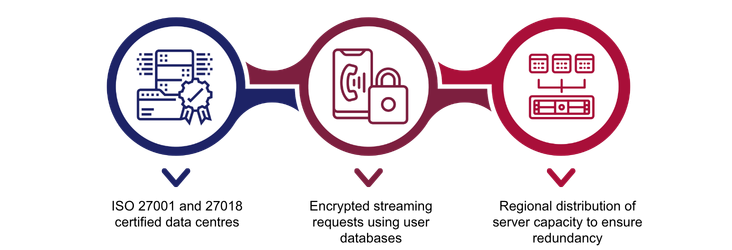
ISO 27001 and 27018 Certified Data Centers
ISO 27001 and 27018 certifications reflect a high level of security and reliability for data centers hosting virtual and hybrid events.
Encrypted Streaming Calls with User Databases
The implementation of encrypted streaming calls in conjunction with user databases significantly increases the security of virtual events. HTTP Live Streaming encryption uses the AES 128 standard for content encryption.
Regional Distribution of Server Capacity for Fail-Safe Operation
The geographic redundancy and distribution of server capacity are crucial for the fail-safe operation of virtual and hybrid events. Distributing data and services across different locations can generally mitigate regional outages.
VPN Solutions for Remote Event Teams
Events are often organized by teams whose members work from different locations. For these distributed and remote-working teams as well, secure access to central systems and platforms is a basic requirement. In most cases, a Virtual Private Network (VPN) ensures that the data traffic between team members’ end devices and the event server is encrypted.
Training and Awareness for Employees
As with all security issues, employee behavior also plays a decisive role in the cybersecurity of virtual and hybrid events. Even the most effective technical security measures can only work properly if employees are informed about potential risks and know how to avoid them. Training and awareness for everyone involved through clear security policies and targeted training programs therefore make a significant contribution to preventing cyberattacks.
Conclusion
Digital events have revolutionized the event industry. They open up new possibilities, but they also bring challenges. They offer greater flexibility, reach, and a better participant experience. However, these advantages also come with specific cybersecurity risks that organizers must not underestimate. Protecting sensitive data, securing the platforms used, and providing targeted employee training are crucial to effectively protecting participant and event data against attacks.
A comprehensive approach, ranging from the selection of secure event platforms and the use of modern encryption technologies to identity and access control measures, forms the foundation for secure digital event delivery. In addition, measures such as securing Wi-Fi networks at physical events and using VPN solutions for remote-working teams protect the entire event process.