Capacity planning and resource planning are key concepts in companies and organizations. These types of planning are intended to support the achievement of defined goals and the optimal design of processes. While these two terms are often confused with one another or even regarded as synonymous, there are fundamental differences in their definitions, objectives, and applications. In this article, we explain the importance of resource planning and capacity planning. We highlight the differences and discuss how they can work together to promote the success of a company or organization.
Definitions and Fundamentals
At the outset, it is important to clearly define the two terms resource planning and capacity planning and to distinguish them from one another.
Resources
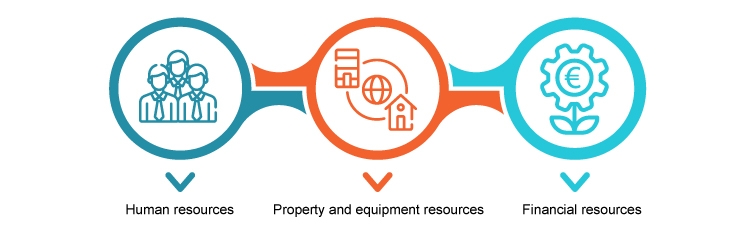
Resources include all available means that can be used to achieve a specific goal. Tangible and plant resources include, for example, raw materials, equipment, and technology. Financial resources refer to the financial means (the budget) available for personnel, materials, and equipment. Human resources represent the employees or staff of the company or organization and also include external workers.
Resource Planning
Resource planning includes identifying the resources required, allocating them according to the needs of different projects or departments, and monitoring their use to ensure that they are used efficiently. Individual areas of resource planning include workforce planning, material requirements planning, and financial planning. Human resources in this context refer to the availability of project team members, which should ideally be recorded and evaluated together with their personnel costs.
Capacities
The term capacities generally refers to the ability of a company or organization to carry out certain tasks or processes. Capacities describe the maximum amount of work an organization can handle within a specific period. Capacities may refer to the production capacity of a factory, the working capacity of a team, or the capabilities of an individual.
Examples of Capacities
Production capacity
A factory has a production capacity of 1,000 units per day. This means that the factory is able to produce up to 1,000 units of its product per day if all resources are used optimally.
Logistics capacity
A warehouse has the capacity to store 10,000 units of a product. This means that the warehouse can accommodate and manage up to 10,000 units of the product without bottlenecks or storage-related issues occurring.
Human capacity
A team of engineers has the capacity to work on up to 5 projects simultaneously. This means that the team is able to manage up to 5 projects in parallel and complete them successfully without compromising quality or efficiency.
Capacity Planning
Capacity planning focuses on a company’s ability to meet demand for its products or services. It includes analyzing current production capacities, forecasting future requirements, and implementing strategies to ensure that the company has sufficient resources available to achieve its production goals.
A distinction is made between strategic and operational capacity planning. While strategic planning is concerned with efficient allocation for long-term and future projects, operational planning deals with the short-term allocation of resources in ongoing projects.
Capacity planning techniques include the use of production planning software, the optimization of manufacturing processes, and the implementation of lean principles. There are various capacity planning strategies. The lead capacity strategy is based on increasing production capacity in anticipation of a predictable increase in demand. Lag strategy planning relies on increasing production capacity because demand is currently higher. Match strategy planning is a combination of lead and lag strategy, in which capacity is increased gradually.
Differences Between Resource Planning and Capacity Planning
The main difference between resource planning and capacity planning lies in their focus and objectives. While resource planning aims to ensure the availability and efficient use of all company resources, capacity planning focuses specifically on production capacities and the company’s ability to meet demand. In other words, resource planning looks at the concrete “what,” whereas capacity planning focuses on the more abstract “how much.”
Challenges and Best Practices
Identifying and clearly naming challenges is just as important as applying best practices in the field of resource and capacity planning. Challenges faced by companies and organizations include suddenly changing demand, bottlenecks in the supply of resources, and legal changes or other new regulatory requirements such as new customs regulations.
Examples of Challenges
-
Demand for products or services can change suddenly, whether due to seasonal fluctuations, market trends, or unforeseen events such as natural disasters or global crises. Such changes can render the original plan obsolete and require adjustments to meet demand while maintaining efficiency.
-
Companies may face bottlenecks in key resources such as raw materials, skilled workers, or production capacities. These bottlenecks can impair the company’s ability to meet demand and achieve planned targets. It is important to identify bottlenecks at an early stage and develop alternative strategies to prevent or manage them.
-
Planning is influenced by a wide range of internal and external factors, including market trends, competition, regulatory requirements, technological developments, and internal corporate strategies. Considering and managing these complex factors is crucial in order to make sound decisions in resource and capacity planning.
Examples of Best Practices
-
Companies should regularly review their planning models and adjust them as needed in order to take current information and environmental changes into account. This may include the use of real-time data, forecasting algorithms, and scenario analyses to enable more precise planning.
-
The use of advanced technologies such as AI, machine learning, and data analytics can improve the efficiency and accuracy of resource and capacity planning. Automation reduces manual tasks and enables faster responses to change.
-
Close collaboration between different departments and teams, including production, sales, procurement, and finance, is essential to enable holistic planning. By sharing information and jointly developing plans, companies can respond better to challenges and make the most of opportunities.
Conclusion
Resource planning and capacity planning play a crucial role in the long-term success of a company by ensuring that it has the necessary resources and capacities to achieve its goals and keep pace with constantly changing market conditions. By understanding and applying these two concepts effectively, companies can strengthen their competitiveness and promote sustainable growth.