The importance of project time tracking in architectural and planning offices
Projects in architectural offices are specific assignments or undertakings handled by architects and their teams. These projects can be very diverse and encompass a wide range of tasks, from planning and designing buildings to supervising the construction process. In addition to the design and planning of new buildings, conversions, renovations or refurbishments as well as urban planning are among these projects.
All projects have a defined beginning and end – in between lies a period that should be planned as well as possible so that the respective project can be carried out and completed successfully. Architectural and planning offices should not do without powerful project time tracking software in their daily work! It enables precise tracking of the hours spent on each project and is therefore a key to increasing efficiency.
This method allows you not only to record the productivity of your employees, but also to assess the profitability of individual projects. Through the digital recording of working hours, you obtain valuable data that is essential for the planning and management of future projects. You can identify bottlenecks at an early stage and allocate resources optimally. Digital project time tracking is therefore a significant element in project management that contributes to cost reduction and quality improvement.
Advantages of digital project time tracking over manual methods
Digital project time tracking offers numerous advantages over manual methods, which can lead to a significant increase in efficiency in architectural and planning offices.
One of the main advantages is precision: Digital systems record working times exactly and in real time, eliminating potential sources of error that can occur with manual recording. In addition, automation ensures a lower administrative workload, as time tracking data no longer has to be transferred manually to other systems. This leads to time savings that can be invested in strategic planning and customer care.
Furthermore, digital solutions offer improved clarity by centrally collecting data, which simplifies project controlling processes and increases transparency. Last but not least, digital project time tracking facilitates invoicing and traceability of project hours, leading to fairer and more accurate billing.
Mobile time tracking for office and construction site
In particular, the introduction of mobile time tracking systems can provide a decisive competitive advantage for architectural and planning offices. With the ability to record working hours both in the office and directly on the construction site in an uncomplicated manner, transparency regarding the hours actually spent on a project increases. This enables more accurate billing, which in turn can increase profitability. The recorded times for certain activities and project categories can also be very useful for planning further comparable project activities.
Digital project time tracking also optimizes teamwork, as the current status of working hours is visible to all project participants. This makes it possible to identify bottlenecks more quickly and plan resources more efficiently. Digital recording also saves a considerable amount of time, as manual entries and the transfer of data are no longer necessary. It paves the way for a future-oriented, efficient way of working in architectural and planning offices.
Tips for using digital project time tracking efficiently
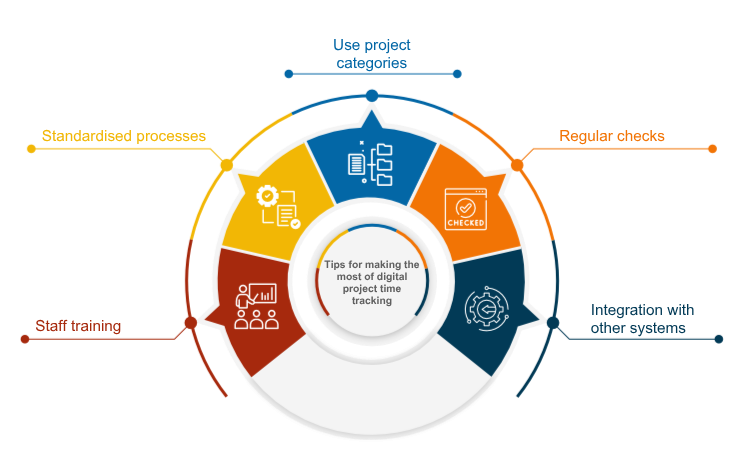
- Training employees: Make sure that all team members are trained in using the software and understand the importance of accurate time tracking.
- Uniform processes: Define standardized processes for time tracking to ensure consistency and comparability.
- Use project categories: Set up detailed project categories to accurately assign times to different tasks. You can find examples of project categories or project activities in the SoftGuide software tips on project time tracking.
- Regular review: Analyze the recorded times regularly to identify potential savings and optimization opportunities.
- Integration with other systems: Connect time tracking with other software solutions to avoid duplicate work and promote a smooth flow of information.
The importance of real-time data and analysis options for increasing efficiency
Digital project time tracking in architectural and planning offices plays a decisive role in increasing efficiency. Real-time data gives you immediate insight into the current status of your projects. You can see where resources are tied up and how time is distributed across different tasks. This enables an agile response to changes and a dynamic redistribution of manpower and budgets.
Analysis options complement real-time data with a deeper level of understanding. They enable you to identify patterns and trends in time tracking that can lead to optimized workflows.
In the long term, these insights help you to calculate project schedules more accurately and identify risks at an early stage. Taken together, real-time data and analysis options ensure transparent, effective and efficient project management.
Identifying and leveraging optimization potential
By precisely recording working hours for different projects, you can identify optimization potential. Careful analysis enables you to see which tasks take a disproportionate amount of time. Unused times also come into focus and can be minimized for future projects. This leads to cost reduction and increases the competitiveness of your office. In addition, the analysis of time tracking data enables more accurate cost estimates for quotations and transparent invoicing to your customers.
Overall, digital project time tracking creates a solid basis for continuous improvements in project management and makes a significant contribution to the professionalization of your office.
Conclusion and summary of the most important findings on digital project time tracking in architectural and planning offices
The introduction of digital project time tracking in architectural and planning offices is an essential step towards increasing efficiency. It enables precise tracking of the working hours spent on individual projects and tasks, which leads to transparent and fair invoicing for customers. By analyzing the collected data, processes can be optimized and bottlenecks identified. The digitization of time tracking not only supports project-related cost estimation, but also improves resource planning and operational efficiency. In addition, it promotes time management within teams and contributes to job satisfaction. Overall, digital project time tracking is a key tool for architectural and planning offices to remain competitive and lay the foundation for a successful future.