Projects form the foundation of many companies and organizations. Whether it is the launch of new products, the development of software solutions, or the construction of infrastructure projects, the success of a project depends largely on careful and effective project planning.
In this article, we examine the fundamental importance of well-thought-out project planning for project success. Using examples from various industries, we show how smart planning can influence the entire course of a project.
Laying the foundation: Why is project planning so important?
Project planning is the foundation of every successful project. It provides the framework that defines the path to the goal. Tasks are identified, resources are allocated, and the schedule, including deadlines and dependencies, is structured. Depending on the type and size of a project, planning also includes risk assessment and quality planning. Both are closely linked to monitoring and control.
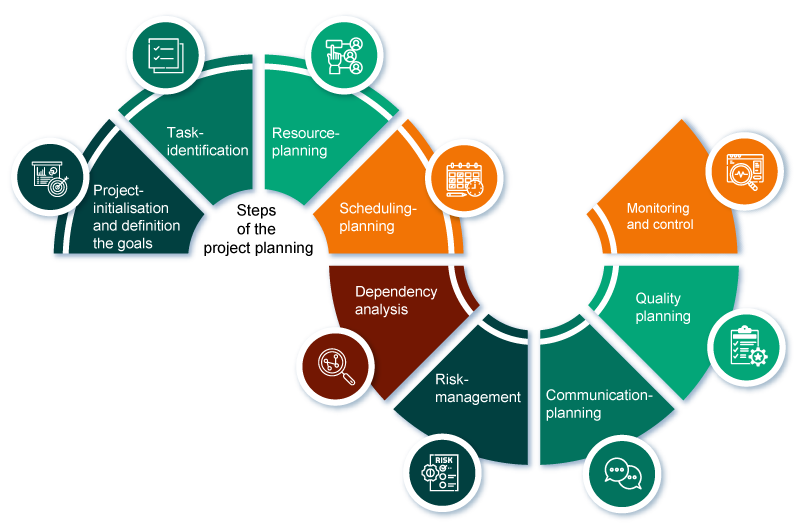
Fig.: Steps of project planning
Well-thought-out project planning offers clear advantages
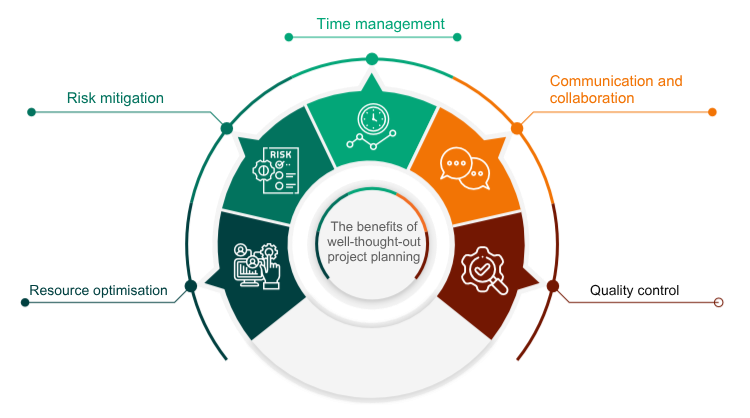
Resource optimization
Financial resources are an indispensable part of every project. Therefore, budget management and thorough financial planning are essential parts of project planning. By allocating financial resources to the various phases of the project, unnecessary financial pressure can be avoided. Careful resource planning also ensures that employees with the right qualifications are in the right place at the right time.
Risk mitigation
Project planning requires a thorough analysis of potential risks. This makes it possible to identify problems at an early stage and develop strategies to counter these risks. In the event of unforeseen circumstances, detailed project planning provides a clear course of action. Teams can react more quickly and overcome unexpected obstacles.
Time management
Clear project planning defines milestones and timelines. These targets are important for systematically monitoring progress. They ensure that the project is completed within the specified timeframe. By identifying critical paths and prioritizing tasks, delays can be avoided or at least minimized.
Communication and collaboration
Project planning serves as a communication tool within the team. Everyone knows their role, responsibilities, and contribution to the overall goal. This promotes transparent and effective communication. Planning enables better collaboration because team members understand their dependencies on one another.
Quality control
Project planning often includes quality standards and checks. This helps ensure that the final product or service meets the defined quality requirements. Regular reviews and audits during the project ensure that quality goals are achieved and that adjustments can be made when necessary.
Examples from practice: How project planning influences success
1. IT projects
In the IT industry, project planning and management are of crucial importance. This applies both to software development and to the selection and implementation of software in a corporate context. Especially when introducing new software, such as an Enterprise Resource Planning (ERP) system, careful advance planning is essential to ensure a smooth transition and long-term success.
Careful project planning enables the phased implementation of IT projects. This is particularly important for complex implementations such as the introduction of an ERP system. Phases may include training, data migration, testing, and live operation, making the entire implementation process structured and manageable.
Smart project planning helps identify potential stumbling blocks at an early stage. These may include technical challenges, resistance within the team, or difficulties during data migration. Early identification enables the team to take preventive measures and develop solutions before critical phases are reached.
Planning includes comprehensive training measures for employees. This ensures that the team can use the new systems effectively. The targeted development of skills minimizes resistance and promotes a positive attitude toward change.
Successful project planning defines clear steps for data migration. This includes checking data integrity, converting data formats, and verifying the data after migration. Comprehensive tests planned in advance help identify potential sources of error before the system is used productively.
Effective project planning ensures a smooth transition from old systems to new ones. A planned rollout ensures that all departments and employees are informed and prepared in good time. Project planning aims to minimize negative effects on day-to-day business processes. The prior identification and resolution of potential problems ensure that daily operations are disrupted as little as possible.
2. Construction
Construction is an industry in which project planning is of crucial importance. A missing or inadequate plan can not only lead to considerable costs but also damage a company’s reputation. Let us look at the construction of an office complex as a concrete example to illustrate the essential role of project planning.
Without clear project planning, different trades such as electricians, plumbers, and construction workers would not be able to work together in sync. This could lead to bottlenecks, where certain work areas would have to wait for others before they could continue. Such inconsistencies usually result in significant construction delays.
Effective project planning creates a detailed schedule. This takes the entire construction process into account and defines clear milestones. The timing of the various trades is optimized to ensure a smooth process and minimize delays.
Project planning generally includes obtaining all required permits and approvals in good time. Planning should consistently include all logistical aspects, from the delivery of materials to the disposal of waste.
Project planning takes safety aspects into account and ensures that all necessary safety precautions are in place.
3. Event management
In the field of event management, precise project planning plays a decisive role in the success of events. Let us take the planning of an international conference with participants from different time zones as a concrete example. Without comprehensive project planning, numerous logistical problems could arise that would not only affect the course of the event but also negatively impact the company’s image.
Effective project planning carefully considers the selection of venues. This includes accessibility for participants, the availability of technology, and suitability for the conference format. Consideration of cultural and logistical differences ensures a pleasant experience for all participants.
Planning also includes the timely booking of accommodations for participants. This is particularly important to ensure lodging close to the venue and to minimize transport problems. A detailed schedule is created that takes the participants’ different time zones into account. This ensures that sessions take place at times acceptable to everyone and that productivity is maximized.
Smart project planning considers the technical requirements of the event. This includes the availability of high-speed internet, sufficient bandwidth for video conferencing, and backup plans in the event of technology failures. Training staff in handling the technology is also taken into account to ensure smooth execution.
Conclusion: Project planning as a success factor
In every project, regardless of industry or size, well-thought-out project planning is the key to success. The examples from different industries illustrate how smart planning influences the entire course of a project and helps achieve objectives on time and efficiently. Companies should therefore recognize the importance of project planning, invest in high-quality planning tools, and ensure that their teams have the necessary skills and resources to deliver successful projects. Sound project planning is not just an option, but an indispensable prerequisite for sustainable success in today’s highly competitive business world.