Flexibility and efficiency are essential to success in retail and hospitality. Customers expect fast purchasing processes, whether they are in a restaurant or a store. Mobile POS systems provide the flexibility needed to process payments anywhere and reduce waiting times, which increases customer satisfaction. As a result, they are becoming an increasingly important tool for efficient, location-independent sales processes.
Mobile POS systems are especially useful in highly dynamic environments such as hospitality and retail. In restaurants, orders can be taken directly at the table and settled immediately, while in retail, customers can be served anywhere on the sales floor. At markets, they provide an ideal solution for location-independent sales.
What are mobile POS systems?
Mobile POS systems are flexible solutions for handling sales processes independently of a fixed location using tablets or smartphones. They offer all essential POS functions and often include additional features such as customer management. These cloud-based systems enable real-time data access and centralized control. Their key advantage is the flexibility they provide in both stationary and mobile sales environments. Their intuitive user interface ensures fast onboarding and smooth day-to-day operations.
How they differ from stationary POS systems
Unlike permanently installed stationary POS systems, mobile solutions support location-independent sales processes without fixed hardware. They use lightweight, portable devices such as tablets or smartphones. This makes them ideal for smaller businesses or temporary sales areas, for example. Mobile POS systems are cloud-based and allow real-time data access from anywhere. They also offer greater flexibility in payment methods, support contactless options such as Apple Pay and Google Pay, and can connect wirelessly to other devices. Stationary systems are often hard-wired and less flexible when it comes to modern payment methods.
Technical foundations: hardware (tablets, smartphones) and software
Hardware
Mobile POS systems use tablets, smartphones, or dedicated POS devices as the central checkout unit. Additional devices such as mobile receipt printers, barcode scanners, or card readers can be connected wirelessly.
Software
These systems are based on cloud platforms that enable real-time data synchronization and comprehensive functions such as inventory management and customer administration. The software is installed as an app on the mobile devices. Cloud-based systems offer high data security, regular updates, and location-independent access to data, which increases business efficiency.
Benefits of mobile POS systems
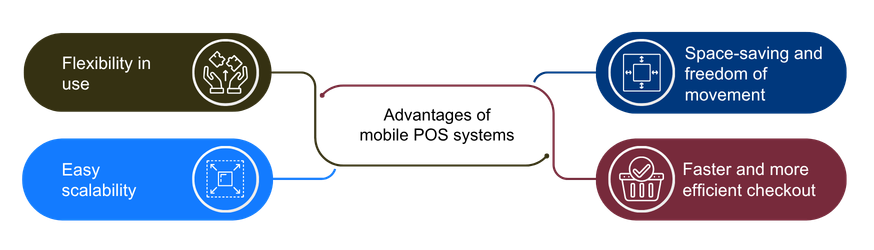
Operational flexibility
Mobile POS systems offer an outstanding level of flexibility that conventional stationary systems cannot match. They are ideal for use in a wide variety of environments, such as markets, pop-up stores, trade fairs, food trucks, or events. They are the perfect solution for businesses that operate at changing locations or regularly sell at events and markets.
Space savings and freedom of movement
A key advantage of mobile POS systems is that they eliminate the need for a fixed checkout area. Stationary POS systems often require dedicated checkout stations that take up valuable space, whereas mobile solutions can be used anywhere in the store. This not only gives employees greater freedom of movement, but also frees up space for other important aspects of the business, such as additional sales area or storage capacity.
Easy scalability
Mobile POS systems are highly scalable, making them ideal for businesses that are growing or planning to open new locations. Most systems allow new devices to be added quickly and easily without extensive technical adjustments. Whether expanding an existing store or opening a new branch, mobile POS systems adapt seamlessly to new requirements.
Faster and more efficient checkout
Mobile POS systems make a major contribution to speeding up and streamlining the checkout process. Because the sales transaction takes place directly at the point of sale (POS), whether in a store, restaurant, or at an event, waiting times can be significantly reduced. Mobile payment processing allows employees to serve customers flexibly and quickly, increasing the efficiency of the entire sales process.
Where can mobile POS systems be used?
Restaurants and hospitality
In hospitality, mobile POS systems have a major impact on efficiency and customer service. They not only make it possible to take orders digitally, but also to manage tables and process payments directly on site.
Retail
In retail, mobile POS systems make it possible to decentralize the checkout process. Employees can assist customers directly on the sales floor and complete the payment process immediately, without customers having to go to a stationary checkout. This shortens waiting times and creates a smooth shopping experience, especially during peak hours or special promotions. Flexible checkout also encourages interaction between staff and customers, enabling service personnel to provide more targeted advice and thereby increase sales.
Markets and events
For vendors at markets, temporary events, or pop-up sales areas, it is essential to have a POS system that is easy to transport and quick to deploy. Mobile POS systems allow sellers to offer their products from virtually anywhere without relying on stationary infrastructure. Thanks to their compact size and ease of use, tablets or smartphones can be easily integrated into mobile sales stands, ensuring that the sales process runs smoothly and efficiently.
Technological developments and trends
Cloud-based solutions and data integration
Centralized data management
By using cloud technologies, all POS data - from sales figures and inventory information to customer data - can be managed centrally and synchronized in real time. This allows businesses with multiple locations or mobile sales areas to access up-to-date data at any time and ensure consistent management across different points of sale.
Real-time analytics and reporting
Cloud-based POS systems also make it possible to generate reports and analyses in real time. Business owners can access this data from any location and make informed decisions about business processes. This is particularly valuable in fast-moving environments such as markets or events, where quick adjustments are often required.
Automatic software updates and data security
Because the software is hosted in the cloud, updates and security measures are carried out automatically. This reduces maintenance effort and ensures that the POS system is always up to date. In addition, the cloud offers a high level of data security through regular backups and encryption, helping protect sensitive customer and business data.
Using AI for personalization and sales optimization
In recent years, artificial intelligence (AI) has also entered the POS sector and offers numerous opportunities to optimize sales processes and strengthen customer loyalty.
Personalized offers and upselling
By integrating AI into mobile POS systems, personalized offers can be created based on customers’ purchasing behavior and preferences. These technologies analyze large volumes of data and identify patterns that make it possible to deliver targeted product recommendations and promotions. AI-supported systems can also automate upselling, which can increase the average sales value per customer.
Automated sales forecasting
AI also helps create sales forecasts and optimize inventory management. Using historical sales data and real-time information, AI can anticipate future fluctuations in demand and help ensure that the right products are always available. This minimizes storage costs and reduces the risk of stock shortages.
Enhanced customer experiences through chatbots and virtual assistants
AI is also increasingly being used to improve customer service. Mobile POS systems can be integrated with chatbots or virtual assistants that answer customer questions, simplify ordering processes, or assist with payments. These technologies help personalize the shopping experience and make customer service available around the clock.
Integration of customer management and loyalty programs
Today, mobile POS systems often offer comprehensive customer management features specifically designed to support long-term customer loyalty. This development is particularly relevant, as personalized and continuous customer interactions are becoming increasingly important for gaining a competitive edge.
Customer data management and segmentation
Modern POS systems can store and manage customer data such as contact details, purchase histories, and preferences. This information enables companies to better understand their customer base and implement targeted marketing measures. Businesses can segment their customers and provide personalized offers based on individual behavior and preferences.
Loyalty programs and rewards
Integrating loyalty programs into mobile POS systems gives businesses the opportunity to retain customers through bonus points, discounts, or special promotions. Loyalty programs are especially effective in encouraging repeat purchases and strengthening trust in the brand. Customers receive regular updates on their points balance and can redeem special rewards directly through the POS system.
Omnichannel experience
Thanks to the integration of customer management and loyalty programs into mobile POS systems, businesses can offer a seamless omnichannel experience. Customers can collect points and manage their purchases both in physical stores and online. This comprehensive integration creates a consistent and user-friendly customer experience, regardless of where the purchase is made.
Conclusion
Mobile POS systems are an innovative solution that makes retail and hospitality more flexible and efficient. They enable businesses to manage sales processes independently of location, reduce waiting times, and at the same time provide customers with a modern, seamless shopping experience. Cloud-based systems offer not only mobility and flexibility, but also high scalability and extensive customer management functions. Combined with new technologies such as artificial intelligence and the integration of loyalty programs, mobile POS systems represent the future of modern retail and hospitality.