In today’s dynamic business environment, companies must constantly adapt to new challenges. Multi-project management therefore plays a pivotal role in ensuring that the right projects are selected, aligned, and executed efficiently. Success depends on careful planning and a clear strategic direction.
The importance of strategic portfolio planning
Strategic multi-project management - also known as strategic portfolio planning - enables organizations to select, coordinate, and align multiple projects in pursuit of overarching business objectives. This approach goes beyond operational project administration: it focuses on prioritizing and aligning projects with long-term corporate goals to maximize overall business value.
Key principles of strategic portfolio planning
Effective portfolio management begins with a well-defined corporate strategy. All project decisions should derive from this strategic foundation. The goal is to identify and pursue projects that deliver the highest benefit to the company while ensuring a balanced use of resources.
Project selection often relies on evaluating initiatives by their attractiveness and risk - that is, weighing potential benefits against possible downsides. Other models emphasize strategic relevance and urgency. Projects may also be prioritized using pairwise comparisons based on predefined criteria or through an influence matrix that highlights interdependencies.
A robust portfolio also requires guaranteeing that adequate resources are available for critical initiatives. Prioritizing active projects helps allocate limited capacities effectively to those with the greatest strategic impact.
Maintaining a well-balanced portfolio - taking risk into account in accordance with ISO 21504 - is key to managing overall corporate risk. Monitoring the impact of plan adjustments safeguards flexibility and helps mitigate negative outcomes. Furthermore, compliance with project governance standards under ISO 21505 ensures that all projects adhere to corporate policies and quality guidelines.
When implemented effectively, strategic multi-project management enhances organizational agility, ensures optimal resource utilization, and increases the overall success of the company’s project portfolio.
Benefits of strategic multi-project management
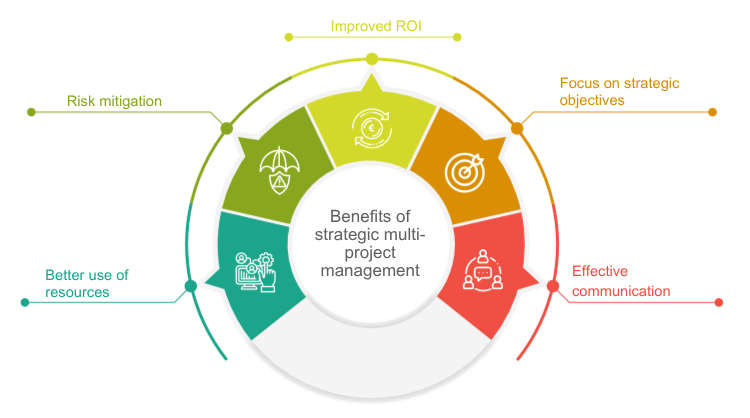
Implementing strategic portfolio planning offers a wide range of benefits for companies.
- Better resource utilization
By selecting and prioritizing projects, companies can ensure that resources are used efficiently. This leads to better capacity utilization and cost efficiency.
- Risk reduction
The systematic identification and assessment of risks enables companies to respond proactively to problems and minimize the risk of project failures.
- Improved ROI
Strategic portfolio planning helps select projects that deliver the greatest business value. This leads to an improved return on investment and the achievement of corporate goals.
- Focus on strategic objectives
Aligning projects with the corporate strategy ensures that all activities are in line with long-term goals and support the company’s vision.
- Effective communication
Strategic portfolio planning promotes communication and transparency within the company. Stakeholders gain clear insight into the strategic direction of the projects.
The role of multi-project management software
Implementing strategic portfolio planning can be a complex task that requires the management and coordination of multiple projects. This is where multi-project management software usually comes into play. These software solutions offer tools and functions that support companies in implementing their strategic portfolio planning. They enable the efficient selection, prioritization, monitoring, and reporting of projects.
Multi-project management software generally offers:
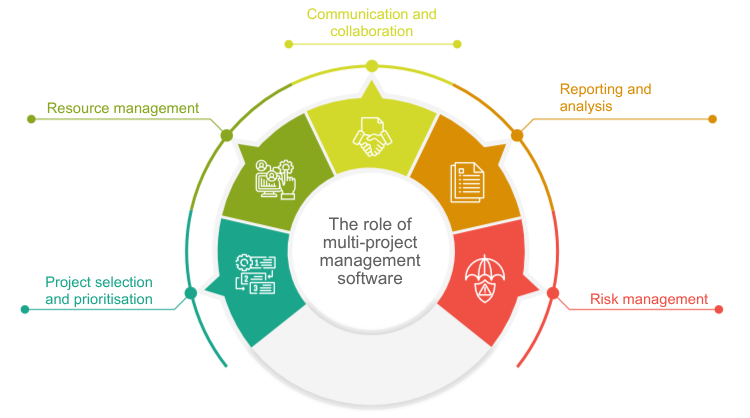
- Project selection and prioritization
The software enables companies to select and prioritize projects based on defined criteria. This means that companies have the ability to identify and choose those projects that best fit their strategic goals and offer the greatest added value.
- Resource management
Companies can effectively manage and allocate resources such as budgets, personnel, and materials with the help of software. By using multi-project management software, it can be ensured that resources are used optimally and that projects are completed on time and within budget.
- Communication and collaboration
The software promotes communication and collaboration between team members and stakeholders. This is often done by providing tools for team communication, document sharing, and tracking tasks and activities.
- Reporting and analysis:
Companies can monitor and analyze the progress and success of projects in real time. The software provides dashboards and reporting functions that make it possible to track key figures and performance indicators.
- Risk management:
The software helps identify and manage risks. It makes it possible to detect potential risks at an early stage and take risk mitigation measures to ensure that projects progress without major disruptions.
The right multi-project management software can significantly simplify the implementation of strategic portfolio planning and increase the effectiveness of this approach.
Conclusion
Strategic multi-project management, and strategic portfolio planning in particular, is a crucial approach to ensuring that projects are aligned with business objectives and that resources are used efficiently. The art of portfolio planning requires a clear strategy, the selection and prioritization of projects, effective resource management, and continuous monitoring. Multi-project management software plays an important role in implementing this approach and enables companies to achieve their strategic goals effectively. With a clear strategic direction and the right software solution, companies can master the art of portfolio planning and secure long-term success.