Social service organizations face complex organizational and administrative challenges every day. Efficient resource management, staff coordination, and ensuring high-quality care are just some of the tasks that can be significantly simplified through the use of specialized software solutions.
The use of software solutions across almost all areas of social service organizations is steadily increasing, and more and more organizations are recognizing the advantages that well-designed and properly implemented software can offer. From planning and optimizing staff deployment to managing client data and documenting care processes and case management, the possibilities are wide-ranging and offer enormous potential for improving both efficiency and service quality.
All-in-one solutions for social service organizations
An all-in-one software solution for social service organizations should cover a broad range of modules and functions in order to meet the diverse requirements of these organizations efficiently. The requirements can vary considerably between social service providers such as healthcare and care organizations, social workers, the German Red Cross, Caritas, Malteser Hilfsdienst, ASB, Johanniter, the Paritätischer Wohlfahrtsverband, and others. Much depends on whether the organization operates a transport service, an emergency call system, residential groups or care homes, a counseling center, Meals on Wheels, or other services.
Key modules of an all-in-one software solution for social service organizations
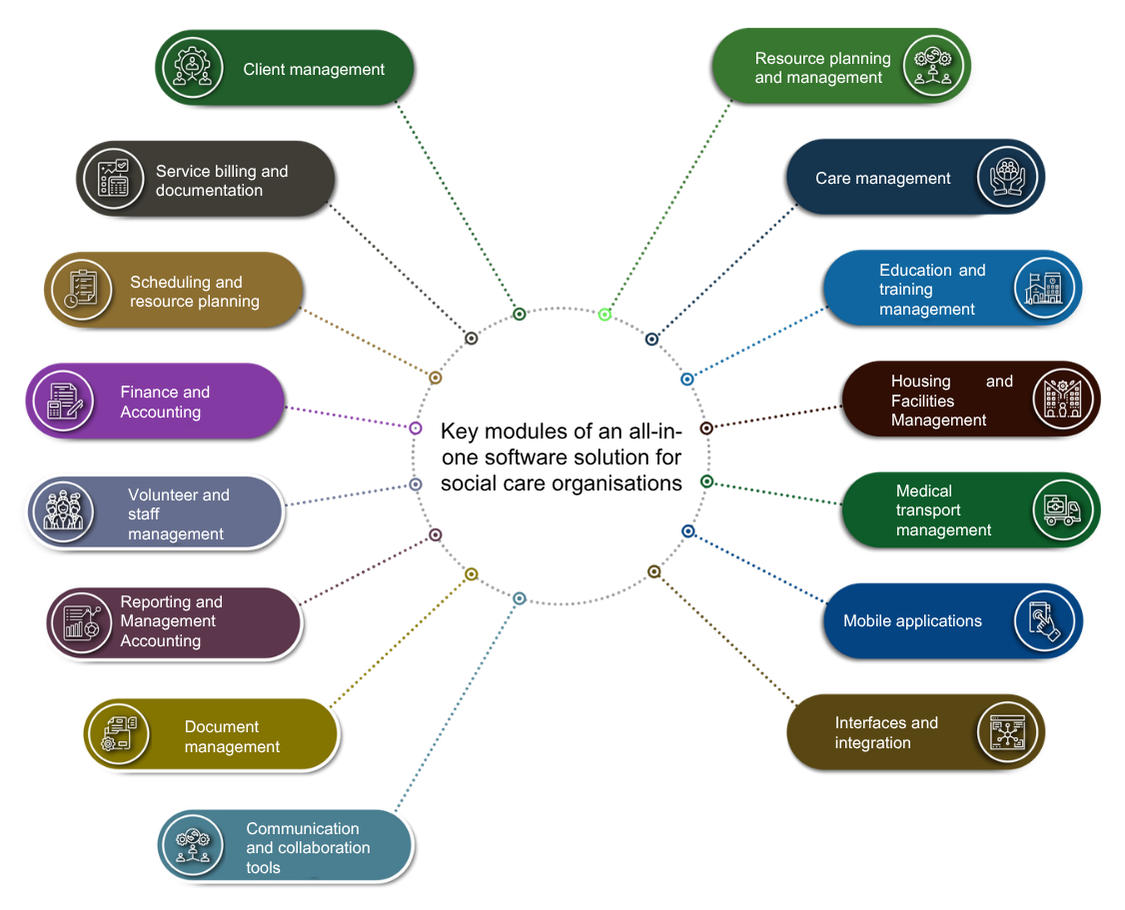
These modules enable social service organizations to manage their operational and administrative processes efficiently, maintain the quality of their services, and comply with legal requirements at the same time.
The advantages of such an all-in-one solution include centralized data management, automated workflows, planning and billing functions, and comprehensive reporting capabilities. One possible drawback is the particularly broad scope of functions, some of which may not be needed in practice. If an all-in-one solution is oversized for your organization because you only require part of the functionality of such a comprehensive system, software solutions for more specialized use cases may be the better choice.
Administrative software for operational processes
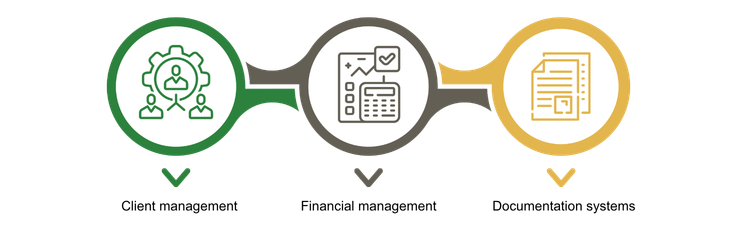
Administrative software forms the backbone of operational efficiency in social service organizations. It enables administrative tasks to be handled smoothly and ensures the necessary transparency and traceability.
Client management
For all social service organizations, it is essential to record and manage comprehensive client data securely and in a structured way. A client management system provides a central database in which all relevant information, such as contact details, care plans, and client histories, is stored and easily accessible.
Financial management
A financial management module can support social service organizations in managing their finances. From budget planning and bookkeeping to billing, these functions help monitor and safeguard the organization’s financial stability.
Documentation systems
Effective documentation systems are essential for meeting legal requirements and making care processes transparent. They enable the detailed recording and management of reports, progress logs, and other relevant documents.
Planning software for efficient resource management
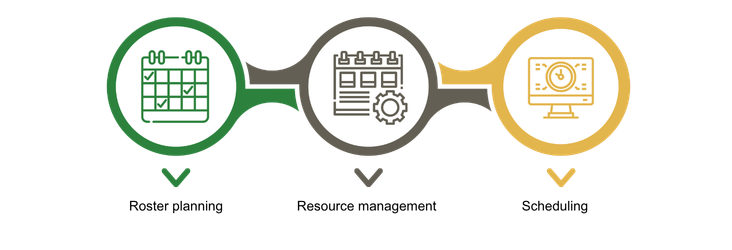
Planning software is crucial for making optimal use of resources and increasing efficiency in day-to-day operations. It helps coordinate staff, rooms, and other key resources.
Shift scheduling
Shift scheduling:
Tools for shift scheduling enable work hours to be allocated efficiently and fairly among employees. They take into account availability, qualifications, and legal requirements, thereby contributing to staff satisfaction and motivation.
Resource management
Resource management functions help plan and optimize the use of rooms, equipment, and other resources. This ensures that all required resources are available in the right place at the right time.
Appointment scheduling
Efficient appointment scheduling tools support the coordination of meetings, therapy sessions, care appointments, and other important events. They offer calendar synchronization functions and enable appointments to be managed and adjusted easily.
Communication software
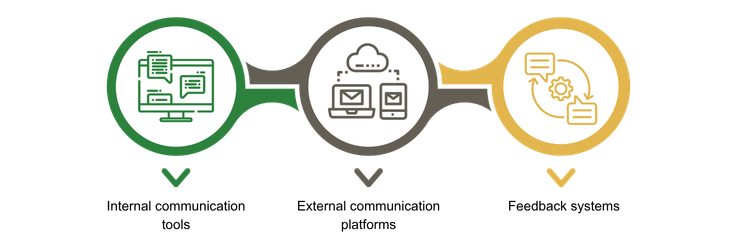
Communication software plays a key role in promoting exchange and collaboration both within the organization and with external partners and clients.
Internal communication tools
Platforms such as intranets or chat applications improve internal communication, encourage information sharing, and support teamwork.
External communication platforms
These tools enable effective communication with clients, family members, and external partners. They offer functions for secure messaging, video calls, and document exchange.
Feedback systems
Feedback systems collect feedback from clients and their family members in order to continuously improve service quality and respond to needs and expectations.
Social‑service‑specific software
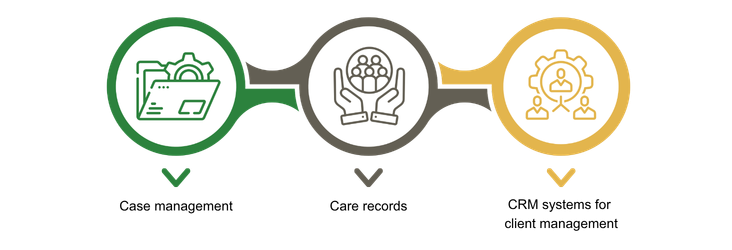
Social‑service‑specific software solutions are tailored to the particular requirements and needs of social service organizations and provide dedicated functions for different areas of care and administration.
Case management
Case management software supports case managers in supervising and tracking cases by centrally consolidating all relevant information and making it easier to coordinate care measures.
Nursing documentation
Nursing documentation software enables detailed and legally compliant documentation of all nursing measures and observations. It simplifies documentation and ensures that all relevant information is available at all times.
CRM systems for client support
CRM systems (Customer Relationship Management) for social service organizations help systematically maintain and manage relationships with clients. They offer functions for managing contact data, communication histories, and care plans.
Benefits of using software for social service organizations
Greater efficiency

Software solutions make a significant contribution to improving efficiency in social service organizations by automating routine tasks and accelerating data processing.
Automation of routine tasks
By automating recurring tasks such as appointment scheduling, billing, and documentation, employees can save valuable time that can instead be devoted to direct client support.
Time savings through faster data processing
Software enables data to be captured, processed, and analyzed quickly. This speeds up decision-making and ensures that information is available quickly and reliably at all times.
Improved accuracy and transparency

The use of digital solutions minimizes errors and ensures greater accuracy and transparency in work processes.
Minimizing errors through digital documentation
Digital systems reduce the risk of errors that can occur with manual data entry. Automated validation functions and integrated checking routines help ensure data integrity.
Easy traceability and transparency of processes
Digital documentation and transparent processes make it possible to trace activities and decisions seamlessly. This increases accountability and makes review and auditing easier.
Better communication and collaboration

Software solutions promote communication and collaboration within the organization as well as with external partners and clients.
Real-time communication and information sharing
Communication software enables the immediate exchange of information and real-time communication between employees. This leads to faster responsiveness and improves coordination.
Simplified collaboration across different departments and locations
Software solutions make collaboration easier across departmental and location boundaries. Shared platforms and central databases ensure that everyone involved always has access to the same up-to-date information.
Optimized resource planning

By using planning software strategically, social service organizations can use their resources more efficiently and avoid bottlenecks.
More efficient deployment planning for staff and materials
Planning software helps optimize and coordinate the deployment of staff and materials. This contributes to avoiding underutilization or overutilization and supports the efficient use of available resources.
Avoiding bottlenecks and overload
Through forward-looking planning and resource monitoring, software can help identify bottlenecks early and ensure that measures are taken in time to avoid overload.
Enhanced data security

Software solutions offer robust security mechanisms to protect sensitive data and support compliance with data protection regulations.
Secure storage and management of sensitive data
Modern software solutions provide high security standards for storing and managing sensitive data. Encryption technologies and access controls protect against unauthorized access and data loss.
Compliance with data protection regulations and legal requirements
Meeting data protection requirements and ensuring compliance with legal regulations are essential. Automated logging and audit functions support compliance efforts.
Improved quality of care

The use of software contributes to improving the quality of care by enabling personalized and well-documented support.
Personalized and well-documented client care
Software solutions enable comprehensive documentation of clients’ individual needs and care histories. This supports personalized care and helps ensure that all relevant information is available at all times.
Better traceability of the care process and measures taken
Digital documentation of the care process and the measures carried out improves traceability and makes it easier to continuously adapt and optimize care.
Future perspectives and trends
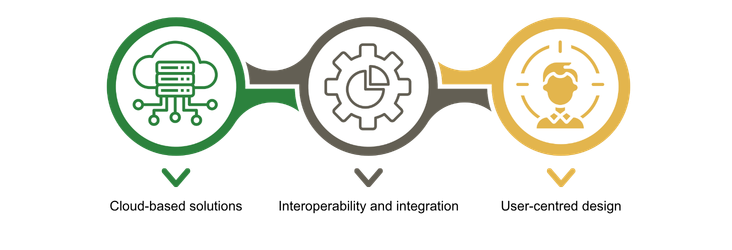
Developments and innovations in the software industry for social service organizations
The software industry is evolving continuously to meet the growing requirements of social service organizations. Numerous innovations and trends are emerging that have the potential to fundamentally change the way social services are delivered and managed.
Cloud-based solutions
Moving software applications to the cloud offers social service organizations flexibility and scalability. Cloud-based solutions enable secure access to data and applications from anywhere, which is particularly beneficial for mobile staff and distributed teams.
Interoperability and integration
Future software solutions will place an even stronger emphasis on interoperability and integration. This means that different systems and applications will work together seamlessly and exchange data efficiently. Better integration improves efficiency and reduces the effort required for manual data transfers.
User-centered design
The usability of software solutions is becoming increasingly important. Future developments will focus on making software more intuitive to use and improving the user experience. This includes personalized user interfaces and context-sensitive assistance.
Potential of artificial intelligence, big data, and other technologies
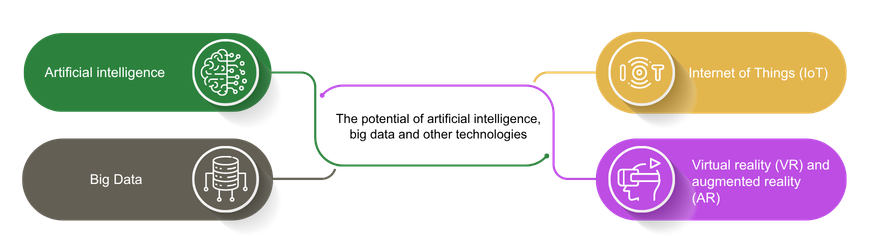
Modern technologies such as artificial intelligence (AI), big data, and the Internet of Things (IoT) offer enormous potential for social service organizations. They can help optimize processes, support well-founded decisions, and improve service quality.
Artificial intelligence
AI can be used in many ways in social service organizations, for example to automate routine tasks, analyze data to identify patterns and trends, and support decision-making. AI-powered chatbots can also serve as a first point of contact for simple inquiries.
Big data
Analyzing large volumes of data enables social service organizations to make informed decisions and take targeted action. By evaluating data, trends can be identified early, resources can be used more efficiently, and the quality of care can be continuously improved.
Internet of Things (IoT)
IoT technologies can help make everyday operations in social service organizations easier. Connected devices and sensors can, for example, monitor health data in real time, trigger alerts, and enable preventive care. This increases the safety and well-being of clients.
Virtual reality (VR) and augmented reality (AR)
VR and AR offer innovative opportunities for training and therapy. Virtual training environments can prepare care staff realistically for different scenarios, while AR applications can support client rehabilitation and therapy.
Conclusion
Specialized software can make the operation of social service organizations easier and more effective by improving the management of client data, staff deployment, and compliance requirements. All-in-one solutions in particular offer comprehensive functions for centralizing and automating processes, which significantly increases efficiency. Future trends such as cloud-based solutions, improved interoperability, and user-centered design, along with technologies such as artificial intelligence, big data, IoT, VR, and AR, offer additional potential for the further optimization and innovation of social services.