-
Solution approach:
To address this challenge, organizations should choose software solutions with comprehensive API interfaces that can be integrated easily into the existing IT infrastructure. Careful planning and close collaboration with IT specialists and software vendors can also help minimize integration issues.
Care documentation is an essential part of daily work in social care facilities, as it not only ensures the quality of care but is also a legal and organizational necessity. Accurate and efficient documentation is crucial for making the care process transparent and for meeting the needs of clients and patients as effectively as possible. Despite its importance, care documentation is still often paper-based and comes with numerous challenges. It is time-consuming, prone to errors, and often difficult to access, which can significantly reduce efficiency and accuracy in everyday care settings.
Software solutions for care documentation offer a worthwhile alternative. They enable faster and more accurate recording of care data, improve the accessibility and timeliness of information, and facilitate communication within the care team. By using modern technologies, social care facilities can optimize documentation processes while simultaneously enhancing the quality of care.
Benefits of Using Care Documentation Software
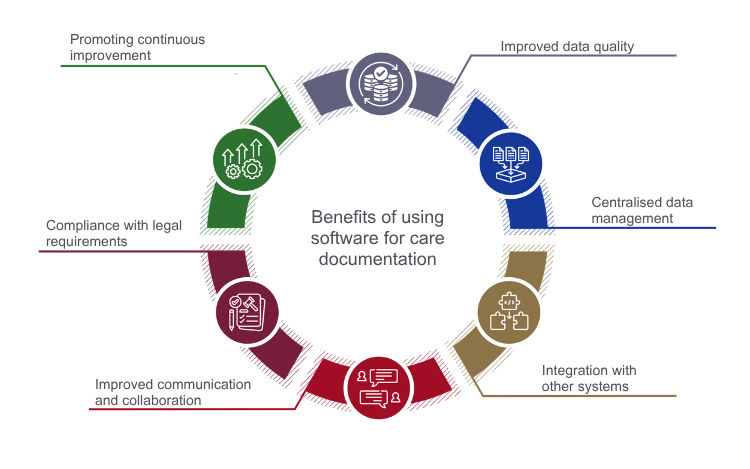
Improved Data Quality and Accuracy Through Automated Data Entry
Implementing software solutions for care documentation can deliver significant benefits through automated data entry. Templates and automated input fields considerably speed up the documentation process. Care staff can rely on predefined forms and checklists tailored specifically to their needs. These templates reduce the effort required for manual entry while also minimizing the risk of errors, as important information is less likely to be forgotten or overlooked. Comprehensive documentation also ensures a high level of traceability and transparency, which is especially important in critical situations. All entries remain fully trackable at all times and can be reviewed quickly whenever needed.
The use of speech recognition technology provides additional advantages. Care professionals can record their observations and reports verbally, and the software converts them into text in real time. This not only saves time but also allows caregivers to focus more on direct client and patient care. Mobile input options such as tablets or smartphones also provide the flexibility to record data directly at the point of care, without requiring staff to return to a fixed workstation.
Centralized Data Management
A key advantage of software solutions in care documentation is centralized data management. By accessing a central database, all relevant information can be stored and managed in one place. This not only simplifies documentation but also makes it easier to track and analyze data.
Real-time synchronization of data across different devices and locations is another major benefit. Care professionals can access up-to-date information from anywhere, improving collaboration and coordination within the team. For example, if a caregiver makes a change to a care plan, it becomes immediately visible to all other team members, regardless of the device they are using or where they are located. This ensures that everyone involved is always informed about the latest status of care.
Integration with Other Systems
Another important aspect is the integration of care documentation software with existing systems and software solutions. Many social care facilities already use various software applications for different tasks, such as billing, scheduling, or medication management. Compatibility and integration with these systems are essential to ensure smooth information flow and seamless collaboration.
API interfaces (Application Programming Interfaces) play a central role here. They enable seamless data transfer between different software solutions and ensure that all systems can communicate with one another. This eliminates the need for duplicate data entry or manual data transfer, increasing efficiency and reducing the risk of errors.
Optimized Communication and Collaboration
An integrated care documentation system also ensures effective communication and collaboration between care staff, physicians, and other employees. Information can be shared quickly and easily, making handovers of information and tasks much more efficient. Thanks to centralized data management, everyone involved has access to the latest data at all times, regardless of location. This significantly improves team coordination and collaboration and helps ensure that care processes run as smoothly as possible.
Compliance with Legal Requirements
An additional benefit of using care documentation software is more effective compliance with legal requirements. Reports and records for audits and inspections can be generated automatically, reducing administrative effort. This is especially important for avoiding potential legal consequences while maintaining a high standard of care.
Promoting Continuous Improvement
Finally, the software also supports the continuous improvement of care processes. Analytical functions make detailed evaluations of care data possible, helping organizations identify areas for optimization. Facilities can implement targeted quality improvement measures and monitor their impact on an ongoing basis. This leads to continuous enhancement of care quality and contributes to the long-term satisfaction of clients.
Challenges and Approaches to Solutions
Integration with Existing IT Systems
Integrating new software solutions into existing IT systems can be complex and time-consuming. Different systems must be compatible and communicate seamlessly with one another to ensure smooth data exchange.
Ensuring Data Security and Privacy
Protecting sensitive data is of utmost importance, especially in healthcare. Data protection regulations must be observed, and appropriate security measures must be implemented to ensure the confidentiality and integrity of data.
Employee Acceptance and Training
The introduction of new technologies can be met with skepticism by employees. Gaining acceptance for the new software and ensuring that all staff can use it effectively may require time and effort.
Overcoming Resistance to New Technologies
Many organizations show a natural reluctance toward change and new technologies. Such resistance can hinder the implementation and effective use of new software.
Procurement and Implementation Costs
Purchasing and implementing new software solutions can involve considerable costs, which may represent a financial burden, especially for smaller social care organizations.
Funding and Financing Opportunities
Digitalization is being promoted by many governments and institutions. There are numerous programs and initiatives that provide financial support for implementing software solutions in social care facilities.
Using Artificial Intelligence and Machine Learning to Improve Care Documentation
Artificial intelligence (AI) and machine learning (ML) are transforming numerous industries, and care is no exception. These technologies offer a wide range of possibilities for optimizing care documentation.
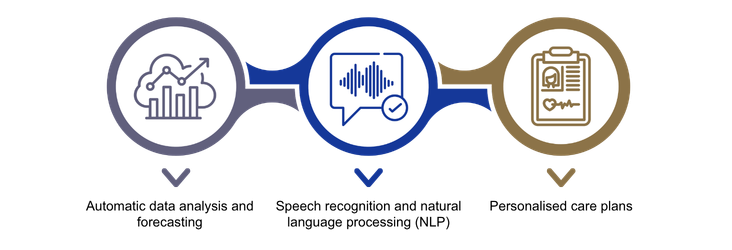
Automated Data Analysis and Forecasting
AI can analyze large volumes of data and identify patterns that are not immediately visible to the human eye. This makes it possible to create precise forecasts and identify risks at an early stage, such as the risk of falls, pressure ulcers, or a general deterioration in a patient’s health condition.
Speech Recognition and Natural Language Processing (NLP)
Modern speech recognition technologies and NLP can significantly simplify documentation. Care professionals can dictate reports and notes verbally, while the software automatically converts and structures them in written form. This saves time and reduces the error rate in data entry.
Personalized Care Plans
ML algorithms can create personalized care plans based on patients’ individual needs and health conditions. These plans can be continuously refined by incorporating real-time data and new insights.
Conclusion
The introduction of modern software solutions for care documentation offers a transformative opportunity to significantly improve quality and efficiency in social care facilities. These technologies address key challenges associated with traditional, often paper-based documentation and provide clear benefits through automated data entry, centralized data management, and improved communication.
By automating documentation processes through templates and speech recognition technology, not only is data accuracy improved, but care professionals also gain more time for direct care. Integration with existing systems and the use of API interfaces enable seamless information flow, optimize collaboration within the team, and support compliance with legal requirements.