This article explains the concept of multi-client capability in accounting software. It outlines the key features and benefits of multi-client accounting software for businesses, accounting service providers, and franchisors. It also explores the situations in which companies need accounting software with multi-client functionality.
What Does Multi-Client Capability Mean?
Multi-client capable software allows a single user to manage multiple clients or business entities simultaneously within one software application or on one server.
In the context of accounting software, the term "multi-client capable" refers to the software’s ability to manage multiple branches, subsidiaries, or companies within a single system. In accounting, clients are separate business entities or companies that need to record, process, and analyze their financial data independently.
Multi-client accounting software enables each client to manage its financial data in a separate and secure environment. Every client can access the software and maintain its own chart of accounts, postings, reports, and other relevant data without any risk of data overlap or unauthorized access to another client’s information.
Key Features of Multi-Client Accounting Software
- Each client can define its own settings for charts of accounts, tax rules, currencies, and other accounting-related parameters.
- The accounting data of each client is stored separately and can only be accessed within the relevant client context.
- The software supports the creation of reports tailored to the specific needs and requirements of each client.
- It includes tools for client management, such as setting up new clients, assigning access rights, and managing user accounts.
- Multi-client accounting software ensures the security and confidentiality of each client’s data, helping prevent unauthorized access and data loss.
Multi-client capability is especially important for accounting service providers, accounting firms, and companies that manage accounting processes for multiple customers. It is also highly relevant for businesses that want to manage separate business units or branch locations independently. This functionality makes it possible to manage, analyze, and report on the financial data of multiple clients efficiently while maintaining data integrity and security standards.
Benefits of Multi-Client Accounting Software
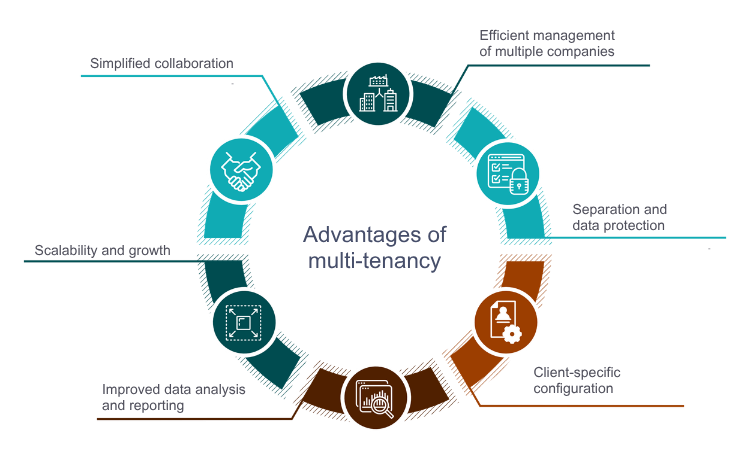
Efficient Management of Multiple Companies
Multi-client accounting software allows accounting service providers and companies with multiple business units to consolidate all financial data within one application or on one server. This improves efficiency by enabling central management of all clients and entities.
Data Separation and Protection
Each client has its own separate database or dedicated area within the software, ensuring strict separation of data. This enhances data protection and helps prevent unintended access or data leaks between clients.
Client-Specific Configuration
Multi-client accounting software allows every client to configure individual settings. This includes adjustments to charts of accounts, tax rules, currencies, and report templates. As a result, each client can tailor the software to its own specific accounting requirements.
Improved Data Analysis and Reporting
Multi-client software makes it possible to generate detailed reports and analyses for each individual client. Because each client’s accounting data can be reviewed separately, financial analysis becomes more precise. It also supports the creation of client-specific reports tailored to individual requirements.
Scalability and Growth
Multi-client accounting software makes it easy to add new clients as a business grows or acquires additional customers. The software can be adapted flexibly to increasing demands and a growing number of clients without major complications.
Simplified Collaboration
If multiple users can work in the multi-client software at the same time, collaboration between accounting teams, clients, and external service providers becomes much easier. Data can be exchanged and processed efficiently, improving both communication and teamwork.
The advantages of multi-client accounting software include efficient management, stronger data protection, flexible configuration options, detailed reporting, scalability, and improved collaboration. Businesses can optimize their accounting processes, increase efficiency, and meet the individual requirements of each client or business unit.
When Do Companies Need Multi-Client Accounting Software?
Businesses typically need multi-client accounting software in the following situations:
Accounting Service Providers
Accounting service providers manage the finances of multiple clients at the same time. Multi-client accounting software enables them to manage all client accounts within a single application or on one server. This improves efficiency and ensures clear data separation.
Companies with Multiple Business Units
Companies with several business units or subsidiaries can benefit significantly from multi-client accounting software. The financial data of each entity can be recorded and managed separately while still being consolidated in one central system. This simplifies both reporting and financial consolidation.
Franchise Businesses
Franchise businesses often operate multiple branches or locations with different financial data. Multi-client accounting software allows the franchisor to record and manage the financial data of each location separately while still maintaining an overall view of the entire franchise network.
Companies with Individual Requirements
Businesses that require specific accounting customizations or configurations also benefit from multi-client software. Each client can maintain its own settings, such as chart of accounts structures, tax rules, or report templates.
Companies with Growth Potential
Businesses planning to expand and add new clients or entities need multi-client accounting software to handle increasing complexity. The software must be able to integrate new clients easily and support long-term business growth.
Overall, companies need multi-client accounting software when they manage multiple clients or entities, require strict data separation, need individual configurations, must meet high data protection requirements, or want to scale their business efficiently. This type of software supports streamlined accounting processes and provides the flexibility required for a wide range of business structures and operational needs.
Conclusion
Multi-client accounting software offers significant advantages for businesses, accounting service providers, and franchisors. It enables the efficient management of multiple clients within one central application or on one server while ensuring strict data separation. Each client can configure its own settings and access its own financial data, while data integrity and data protection standards remain fully maintained. The software also supports detailed reporting and analysis, improves collaboration between accounting teams and clients, and scales flexibly as the business grows. Companies, accounting firms, and franchise organizations with multiple business units or individual requirements can use multi-client accounting software to optimize accounting processes, improve efficiency, and meet the unique needs of every client.