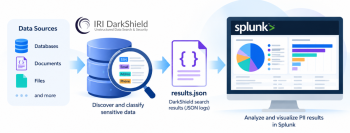
Automated data classification, data masking and graphical analysis of personal information for greater transparency and data security!
Every day, organisations process enormous volumes of personal and confidential information in databases, documents, files and applications. However, they often lack a complete overview of where sensitive data is located, which information requires particular protection, and how effectively data protection measures have been implemented.
Particularly in complex IT environments containing structured, semi-structured and unstructured data, the detection and classification of personal information is becoming an increasing challenge.
By combining IRI DarkShield and Splunk Enterprise, sensitive data can not only be automatically identified and masked, but the results of these processes can also be analysed, visualised and documented in a traceable manner.
Automatically detect and classify personal data!
IRI DarkShield supports organisations in searching for personally identifiable information (PII), protected health information (PHI) and other confidential content.
This includes, for example, names, addresses, telephone numbers, email addresses, identification numbers and other sensitive information.
The software scans various data sources, including databases, PDF and Office documents, images, and both structured and unstructured files. Detected information is assigned to predefined data classes and can subsequently be secured through masking, pseudonymisation or other appropriate protection methods.
This creates an important foundation for systematic data protection: organisations can identify what sensitive information is present and where appropriate protective measures are required.
DarkShield and Splunk make data protection measures visible: a key advantage of combining the two technologies lies in the analysis of the search and masking logs generated by DarkShield. Whilst DarkShield identifies, classifies and protects sensitive information, Splunk Enterprise handles the analysis and graphical representation of the logged results.
DarkShield provides various JSON log files for this purpose:
- annotations.json documents the locations of detected sensitive information.
- results.json contains search and masking results, including the masking functions used and the protected replacement values.
- audit.json provides statistical information and details on the execution of the processing.
These logs can be imported into Splunk and analysed using the Splunk Search Processing Language (SPL).
This gives IT security managers a more detailed overview of the results of data detection and data masking.
Analyse and visualise sensitive data with Splunk!
Splunk enables the statistical analysis and graphical representation of the data classes detected by DarkShield.
For example, it is possible to determine how frequently email addresses, names, telephone numbers or identification numbers were found in the data sets examined.
The results can be visualised as tables, bar charts or pie charts. Data classes that occur particularly frequently can be specifically identified and compared.
This provides transparency regarding the distribution and frequency of sensitive information. Companies can use these insights to review their data protection strategies, identify additional risks and set priorities for further protective measures.
The analysis therefore offers more than mere logging: technical search results are transformed into actionable information for data protection, IT security and compliance.
Supporting data protection monitoring and GDPR requirements: The General Data Protection Regulation (GDPR) requires appropriate technical and organisational measures to protect personal data.
In addition to the actual data masking, the traceability of the data protection processes carried out is therefore becoming increasingly important. The combination of DarkShield and Splunk helps organisations to systematically analyse the results of data detection and to document the processing steps carried out more transparently.
This can be particularly helpful for data protection officers, IT security managers and compliance departments in assessing and improving existing data protection measures.
Log analysis complements technical safeguards and can be used as part of a comprehensive data protection and governance framework. However, this alone does not ensure full GDPR compliance.
Enhanced data governance with IRI FieldShield and CoSort:
The analysis functions are not strictly limited to DarkShield logs.
Through the IRI Operational Governance System (OGS), operational log information from other IRI data-processing processes is also available.
This includes, for example, structured data-processing and masking tasks using IRI CoSort and FieldShield. The corresponding audit information can also serve as a basis for further analyses. This allows different data processing and data protection processes to be integrated into a comprehensive monitoring framework.
Greater transparency and control over sensitive corporate data!
Organisations must not only protect personal data, but also be able to track which information has been identified and which protective measures have been applied.
IRI DarkShield provides the technical foundation for this through automated data detection, data classification and data masking. Splunk complements these functions with flexible search, analysis and visualisation capabilities.
JET-Software supports businesses and public sector organisations with data protection technologies from Innovative Routines International (IRI) to ensure the secure processing of sensitive information in heterogeneous IT environments.
The result is greater transparency regarding sensitive data, traceable data protection processes and a stronger foundation for effective data security!
Efficiency meets experience: For more than four decades, our software solutions have been supporting companies in data management and data protection – technologically leading, reliable in productive use and applicable across all industries.
In use since 1978: Numerous well-known companies, service providers, financial institutions and state and federal authorities are among our long-standing customers.
Maximum compatibility: Our software supports both classic mainframe platforms (Fujitsu BS2000/OSD, IBM z/OS, z/VSE, z/Linux) and modern open system environments such as Linux, UNIX derivatives and Windows.